
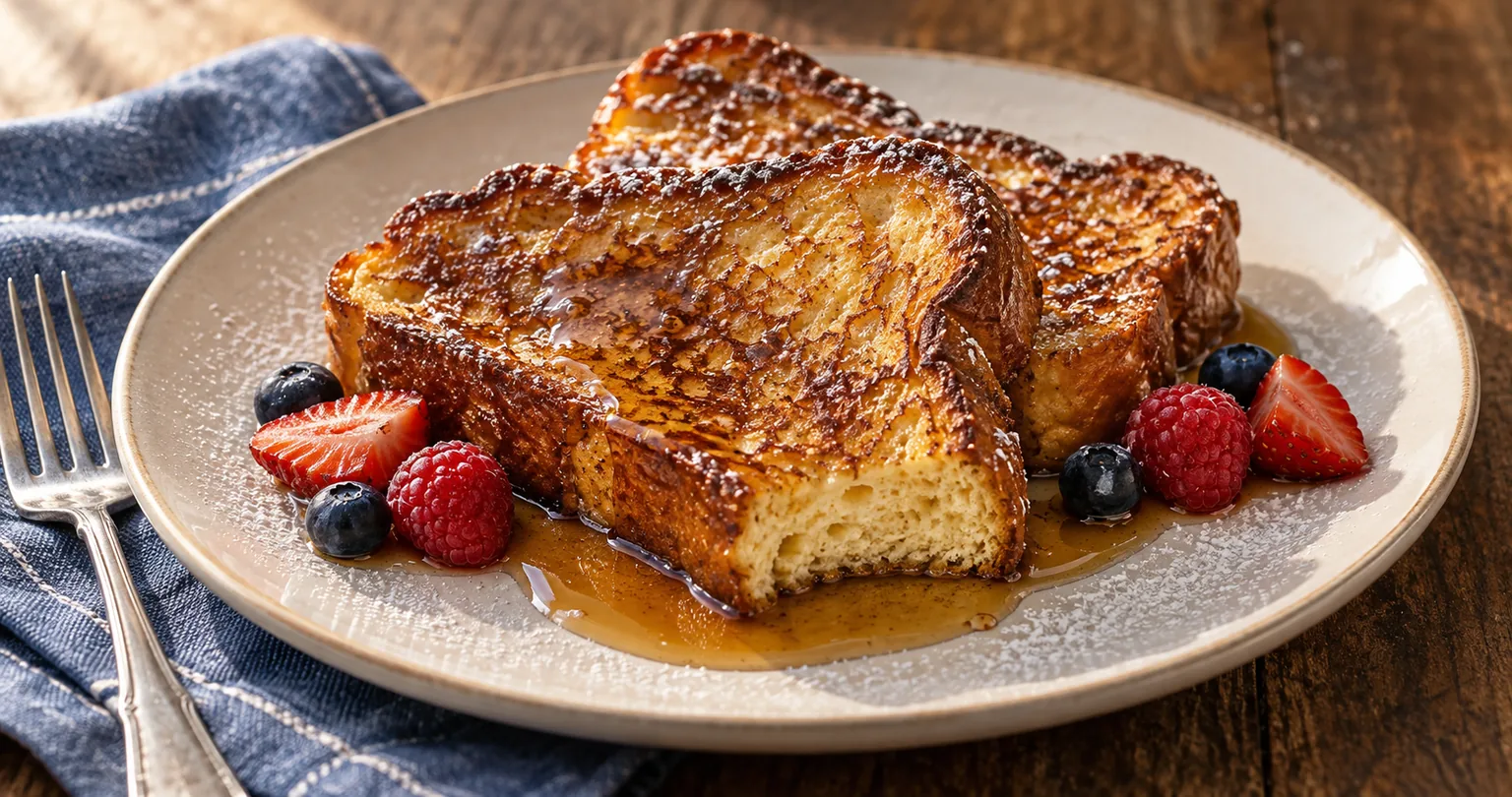
French toast
- Yield
- 4 servings
French toast turns bread that's a day past its prime into breakfast. It teaches two things you'll use far beyond this dish: making a simple custard, and cooking something egg-rich gently enough that the center sets before the outside burns.
IngredientsTips are one tap away.
Ingredients
Batches and reset
4 servings · US measures · 1 batch
Batching
Make a separate dish of custard for each batch and cook the slices 2 at a time; cooking time does not change with the number of batches.
Original recipe: 4 servings.
Nutmeg and the maple syrup, powdered sugar and berry toppings are optional and excluded from the base nutrition scenario, as are extra salt, sugar and milk added at the tasting step. Nutrition is incomplete because the amount of pan butter and oil absorbed by the toast is not established.
Before you start
- Read through the recipe before heating the pan. Gather the dish, skillet, rack, tools and measured ingredients.
Directions
Read and gather
For the whole recipe
Read through the recipe and gather the equipment. Use the ingredient lines to prepare and measure everything, and set the wire rack on the baking sheet. Everything is measured and the rack is on the baking sheet.
Heat the oven for holding
For each batch
Heat the oven to 200°F with the rack and baking sheet on the middle rack, for holding the finished slices. The oven has reached temperature.
Whisk the custard
For each batch
Whisk 2 tbsp granulated sugar, the cinnamon, ground nutmeg to taste, if using, and 1/4 tsp fine salt in the shallow dish. Add the eggs and whisk until completely smooth with no white streaks, about 1 minute. Whisk in about 1 cup whole milk and the vanilla.
Set the pan over the heat
For each batch
Set the 12-inch skillet over medium-low to medium heat with 1 tbsp unsalted butter and 1 tsp canola oil. Heat until the butter foams and the foam starts to settle, about 2 minutes.
Soak two slices
For each batch
Soak 2 slices day-old challah in the custard, turning once, until soft and heavy through but still holding their shape, about 15 to 30 seconds per side. Lift each slice with the turner, letting the extra custard drip back.
Cook the first slices
For each batch
Cook the soaked slices over medium-low to medium heat until deep golden underneath and releasing easily, then flip. Cook until the second side is golden, the center springs back and an instant-read thermometer slid sideways into the middle reads 160°F (71°C), about 3 minutes per side. Move them to the rack in the oven.
Taste and adjust the custard
For each batch
Taste a corner of a slice that reached 160°F (71°C). Aim for warm vanilla custard, lightly sweet and spiced, not eggy. If it tastes flat, add fine salt to taste to the custard; if it is not sweet enough, add granulated sugar to taste; if it tastes eggy, whisk in whole milk to taste, no more than about 1/2 cup for this batch. Whisk the custard well before the next dip. The custard is tuned for the next slices.
Cook the next rounds
For each batch
Cook the next 3 rounds the same way over medium-low to medium heat, 2 slices at a time, using 6 slices day-old challah, 3 tbsp unsalted butter and 3 tsp canola oil, with a third of the butter and oil going into the pan for each round. Wipe the skillet with a paper towel held in tongs whenever the butter darkens, and check each round with the thermometer before moving it to the oven. Every slice is golden and reads 160°F (71°C) in the center.
Divide and serve
For the whole recipe
Divide the French toast among warm plates, 2 slices each, to make 4 servings. Top with warm maple syrup, powdered sugar and fresh berries to taste, if using. Each plate has 2 golden slices.
About this recipe
Research preview: these details come from our sourced research and haven't been reviewed by our chef yet.
Why it works
Associated with
European, American
A Roman Apicius recipe is sometimes cited as a precursor; Taillevent gave 'tostées dorées' around 1300 and 14th-century German texts mention 'Arme Ritter'. The name 'French toast' is first recorded in 1660 (without eggs); in France it is pain perdu, 'lost bread', made from stale bread.
Taste
- Sweet
- Sour
- Salty
- Bitter
- Savory
- Heat
crisp golden outside, soft custardy center · hot
Skill level
Easy
Directional; the thermometer step follows FDA egg-dish guidance.
Allergens
Contains: egg, milk, wheat
Diets
Vegetarian: Fits as listed Vegan: Doesn't fit as written
Occasions
Shabbat leftovers (Saturday night/Sunday), Lent / Holy Week (Spain: torrijas), Christmas (Portugal/Brazil: rabanadas), Passover
Serving and keeping
Make ahead: dry the bread a day ahead; cook to order
Leftovers: to 165°F (74°C), toaster or oven
Food safety
- 160
- 71
- egg dishes/casseroles to 160°F
- raw egg; do not taste the custard (the recipe's tasting is of cooked slices, step 6)
- challah is often sesame-topped
Nutrition notes
Four large eggs across 4 servings supply protein; challah (USDA 'Bread, egg') provides 9.5 g protein and 3 mg iron per 100 g.
For your food tracker
Fields for MyFitnessPal and other trackers
- Recipe url
- https://isthebestrecipe.com/breakfast/french-toast
- Name
- French toast
- Servings
- 4
- Recipe yield
- 4 servings
- Recipe ingredient
- 2 tbsp granulated sugar, 1/2 tsp ground cinnamon, 1/4 tsp fine salt, 4 whole large eggs, about 1 cup whole milk, 1 tsp vanilla extract, 4 tbsp unsalted butter for the pan, 4 tsp canola oil for the pan, 8 slices day-old challah each 3/4 inch thick
- Copy action wording
- Copy recipe and estimated nutrition
Sources
- French toast (Wikipedia)
- French toast (Wiktionary)
- What You Need to Know About Egg Safety (U.S. Food and Drug Administration, 2024-03-05)
- Food Allergies (U.S. Food and Drug Administration, 2026-03-11)
- Challah (Wikipedia)
- List of 14 Allergens (Food Safety Authority of Ireland)
- Food Storage (University of Nebraska-Lincoln Extension (Food))
- FoodData Central: Bread, egg (USDA Agricultural Research Service, FoodData Central, 2019-04-01)
Make it the best
Copy this recipe and make it your own. Change amounts, swap ingredients, rewrite steps. The original stays as it is.
Nutrition Values
Nutrition estimates aren’t available for this recipe yet.
Your notes
Kept on this device.Return: https://isthebestrecipe.com/breakfast/french-toast