
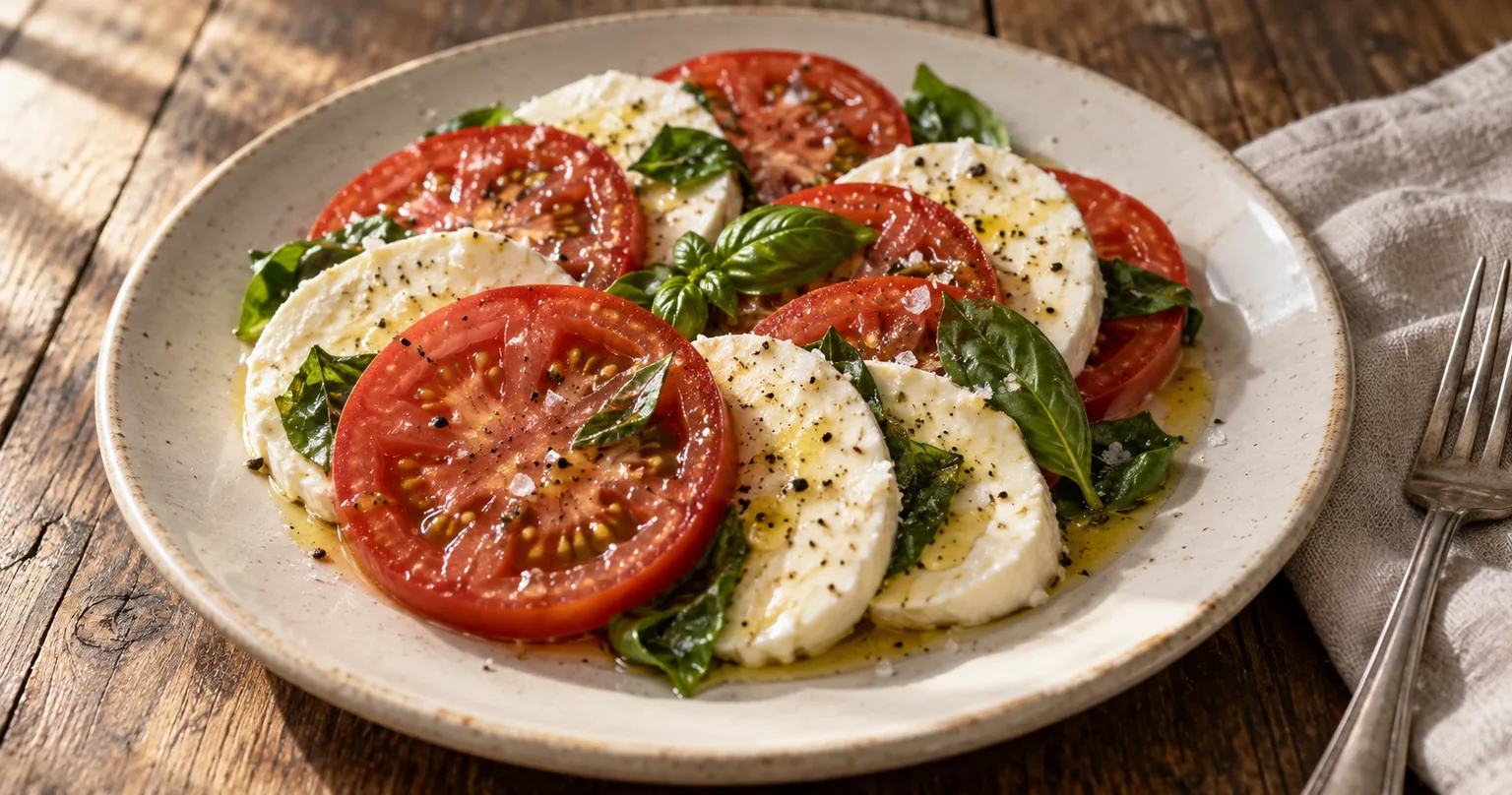
Caprese salad
- Yield
- 4 servings
Tomatoes, fresh mozzarella, basil and olive oil, with nothing to hide behind. There's no stove involved, so the lesson is in the choices you make: ripe tomatoes kept out of the refrigerator, salt given a few minutes to work, cheese that isn't fridge-cold, and basil torn only at the last moment.
IngredientsTips are one tap away.
Ingredients
Batches and reset
4 servings · US measures · 1 batch
Batching
Arrange one batch on each platter about 12 by 16 inches; for a larger yield, use a second platter. Salting and tasting cues do not multiply with ingredient quantities.
Original recipe: 4 servings.
The optional black pepper and red wine vinegar and any extra flaky salt are excluded from the base nutrition scenario. Fine salt replaces the source kosher salt. Nutrition is incomplete because the flaky sea salt mass per teaspoon is not established.
Before you start
- Read through the recipe before you start. Gather the knife, cutting board, paper towels, platter and the measured ingredients, with the mozzarella out of the refrigerator first.
Directions
Read and gather
For the whole recipe
Read through the recipe and gather the equipment. Take the mozzarella out of the refrigerator first, still in its liquid, so it is not fridge-cold when you eat it. Use the ingredient lines to prepare and measure everything, slicing the tomatoes with long, light strokes so the knife cuts without crushing. Everything is prepared and measured before you start assembling.
Overlap the tomatoes and salt them
For each platter
Overlap the slices of about 2 lb ripe tomatoes on the platter and sprinkle them with 1/4 tsp fine salt. Let them sit until small beads of juice appear on the cut faces, about 10 minutes.
Tuck in the mozzarella
For each platter
Tuck the slices of about 1 lb fresh whole-milk mozzarella between the tomato slices so cheese and tomato alternate down the platter. The cheese and tomato alternate down the platter.
Tear the basil and dress the platter
For each platter
Tear 20 whole large fresh basil leaves and tuck them among the slices. Drizzle with 3 tbsp extra-virgin olive oil, then sprinkle with 1/2 tsp flaky sea salt and black pepper to taste, if using. The platter is dressed with basil, oil and salt.
Eat a bite and adjust
For each platter
Eat a piece of tomato with a piece of mozzarella. Aim for tomato that is sweet, a little tart and clearly seasoned, and cheese that tastes milky, not bland. If the tomatoes taste flat, sprinkle on flaky sea salt to taste. If they taste sweet but lack tang, sprinkle them with 1/2 tsp red wine vinegar, if using. The tomato and cheese taste seasoned and balanced.
Serve right away
For the whole recipe
Serve the salad right away from the platter or on plates, to make 4 servings. Refrigerate leftovers within two hours (one hour above 90°F); chilled tomatoes turn mealy, so eat them soon. The salad is served at room temperature.
About this recipe
Research preview: these details come from our sourced research and haven't been reviewed by our chef yet.
Why it works
A few minutes of salt pulls juice from the tomatoes and concentrates their flavor. Mozzarella out of the refrigerator early tastes milkier and feels softer, basil torn at the last minute keeps its edges green, and oil and flaky salt go on at the end for shine and crunch.
Associated with
Italian (Campania)
Insalata caprese is named for the island of Capri. Accounts tie its popularity to Capri in the 1920s and its wider fame to the 1950s, and its colors are said to echo the Italian flag; exact origins are disputed. In Italy it is an antipasto served without vinegar.
Taste
- Sweet
- Sour
- Salty
- Bitter
- Savory
- Heat
Ripe tomato, sweet and a little tart, against milky fresh mozzarella., Basil, fruity olive oil and crunchy flaky salt finish the plate. · juicy tomato, soft, milky cheese, tender basil · room
Skill level
Easy
No cooking. The skill is in the timing and in choosing ripe tomatoes and good cheese.
Allergens
Contains: milk.
Check the mozzarella label and, if you use it, the red wine vinegar label for sulfites.
Diets
Vegetarian: Depends on what you buy Pescatarian: Depends on what you buy Vegan: Doesn't fit as written Dairy: See the allergen lines Egg: See the allergen lines Gluten: See the allergen lines
Occasions
Lenten abstinence days (Ash Wednesday and the Fridays of Lent)
No meat is listed, and cheese is permitted on abstinence days.
Serving and keeping
Best served: Right away, as soon as the platter is dressed From the platter or on plates, as an antipasto or a side
Make ahead: Assemble, tear the basil and dress the platter when serving.
Storage: Do not leave the salad out more than 2 hours (1 hour above 90 °F / 32 °C); refrigerate leftovers at 40 °F (4 °C) or below. Chilled tomatoes turn mealy, so eat leftovers soon.
Leftovers: Chilled tomatoes turn mealy and the cheese firms up; leftovers are softer and less fresh.
Food safety
- Young children, older adults, pregnant people and anyone with a weakened immune system should use mozzarella made with pasteurized milk; check non-traditional or artisanal cheeses.
- Do not leave the salad out more than 2 hours (1 hour above 90 °F / 32 °C); refrigerate leftovers.
We make no statement about cross-contact in your kitchen or in packaged ingredients. Check the mozzarella label.
Nutrition notes
Most of the sodium comes from the mozzarella and the finishing salt. Using less salt, or a lower-sodium mozzarella, keeps it lower.
Most of the saturated fat comes from the whole-milk mozzarella.
The mozzarella brings protein and calcium; the tomatoes bring vitamin C and vitamin A.
Swap notes
fresh whole-milk mozzarella · vegetarian
Use: fresh mozzarella labelled with microbial rennet
What changes: No change to taste.
Not a swap: Low-moisture block mozzarella, the kind for pizza: firm, salty and rubbery raw.
fresh whole-milk mozzarella · halal.general
Use: halal-certified or microbial-rennet fresh mozzarella
What changes: No change to taste.; If you avoid wine vinegar, skip it or use a few drops of fresh lemon juice.
Not a swap: A mozzarella whose label says only "enzymes" or animal rennet.
fresh whole-milk mozzarella · young children, older adults, pregnant people or a weakened immune system
Use: mozzarella made with pasteurized milk
What changes: No change to taste.
Not a swap: Raw-milk artisanal mozzarella.
fresh whole-milk mozzarella · orthodox.fast_strict
What changes: Leave out the mozzarella; it becomes a tomato and basil salad.; On strict weekdays also leave out the olive oil.
Not a swap: Any cheese, which is dairy.
fresh whole-milk mozzarella · vegan
Not a swap: Fresh mozzarella is half the dish; no tested stand-in without dairy is recorded.
fresh whole-milk mozzarella · different fresh cheese
Use: burrata, buffalo mozzarella or halved bocconcini
What changes: Burrata is richer and runs, so tear it over the top instead of slicing.; Buffalo mozzarella is tangier and wetter, so pat it drier.
Not a swap: Low-moisture block mozzarella, the kind for pizza: firm, salty and rubbery raw.
ripe tomatoes · tomatoes out of season
Use: halved cherry or grape tomatoes, or heirloom tomatoes
What changes: Halved small tomatoes need only about 5 minutes of salting.
Not a swap: Canned whole tomatoes, which are soft and taste cooked.
large fresh basil leaves · no basil on hand
Use: a few mint leaves, or small arugula leaves
What changes: Mint is stronger, so use about half as many leaves; arugula brings pepper instead of sweetness.
Not a swap: Dried basil, which has no fresh aroma and is gritty on raw food.
extra-virgin olive oil · different olive oil
Use: another extra-virgin olive oil, peppery or mild
What changes: A peppery oil gives a sharper finish; a mild one lets the tomato lead.
Not a swap: Neutral vegetable oil, which is fat with no flavor.
These notes don't change the amounts, allergens or nutrition shown for this recipe.
For your food tracker
Fields for MyFitnessPal and other trackers
- Recipe url
- https://isthebestrecipe.com/salads/caprese-salad
- Name
- Caprese salad
- Servings
- 4
- Recipe yield
- 4 servings
- Recipe ingredient
- about 2 lb ripe tomatoes about 4 large, a mix of colors if you can find them, kept at room temperature, cored and cut into 1/3-inch rounds, 1/4 tsp fine salt, about 1 lb fresh whole-milk mozzarella packed in water, made with pasteurized milk, patted dry and cut into 1/3-inch slices (torn if too soft to slice), 20 whole large fresh basil leaves rinsed, patted dry and kept wrapped in a dry paper towel until torn, 3 tbsp extra-virgin olive oil one you enjoy tasting on its own, 1/2 tsp flaky sea salt such as Maldon
- Copy action wording
- Copy recipe and estimated nutrition
Sources
- FoodData Central: Tomatoes, red, ripe, raw, year round average (FDC ID 170457) (USDA Agricultural Research Service, FoodData Central, 2019-04-01)
- FoodData Central: Cheese, mozzarella, whole milk (FDC ID 170845) (USDA Agricultural Research Service, FoodData Central, 2019-04-01)
- Food Allergies (U.S. Food and Drug Administration, 2026-03-11)
- Regulation (EU) No 1169/2011, Annex II: Substances or products causing allergies or intolerances (legislation.gov.uk copy, as amended by Delegated Regulation (EU) No 78/2014) (legislation.gov.uk (The National Archives), 2011-10-25)
- Sulphites: One of the priority food allergens (Health Canada)
- Leftovers and Food Safety (USDA Food Safety and Inspection Service, 2020-07-31)
- FoodKeeper data (foodkeeper.json) (USDA Food Safety and Inspection Service (with Cornell University and FMI))
- People at Risk: Pregnant Women (FoodSafety.gov (HHS/USDA/FDA/CDC), 2026-10-05)
- Disciplinare della specialità tradizionale garantita «Mozzarella Tradizionale» (Gazzetta Ufficiale Serie generale n. 191, 17-8-2022) (Gazzetta Ufficiale della Repubblica Italiana (copy hosted by Regione Veneto), 2022-08-17)
- FoodData Central: Vinegar, red wine (FDC ID 172240) (USDA Agricultural Research Service, FoodData Central, 2019-04-01)
- FoodData Central: Basil, fresh (FDC ID 172232) (USDA Agricultural Research Service, FoodData Central, 2019-04-01)
- FoodData Central: Oil, olive, salad or cooking (FDC ID 171413) (USDA Agricultural Research Service, FoodData Central, 2019-04-01)
- Daily Value on the Nutrition and Supplement Facts Labels (U.S. Food and Drug Administration)
- 21 CFR 101.54 Nutrient content claims for 'good source,' 'high,' 'more' (Legal Information Institute, Cornell Law School (reproducing the eCFR))
- 21 CFR 101.61 Nutrient content claims for the sodium content of foods (Legal Information Institute, Cornell Law School (reproducing the eCFR))
Make it the best
Copy this recipe and make it your own. Change amounts, swap ingredients, rewrite steps. The original stays as it is.
Nutrition Values
Nutrition estimates aren’t available for this recipe yet.
Your notes
Kept on this device.Return: https://isthebestrecipe.com/salads/caprese-salad