
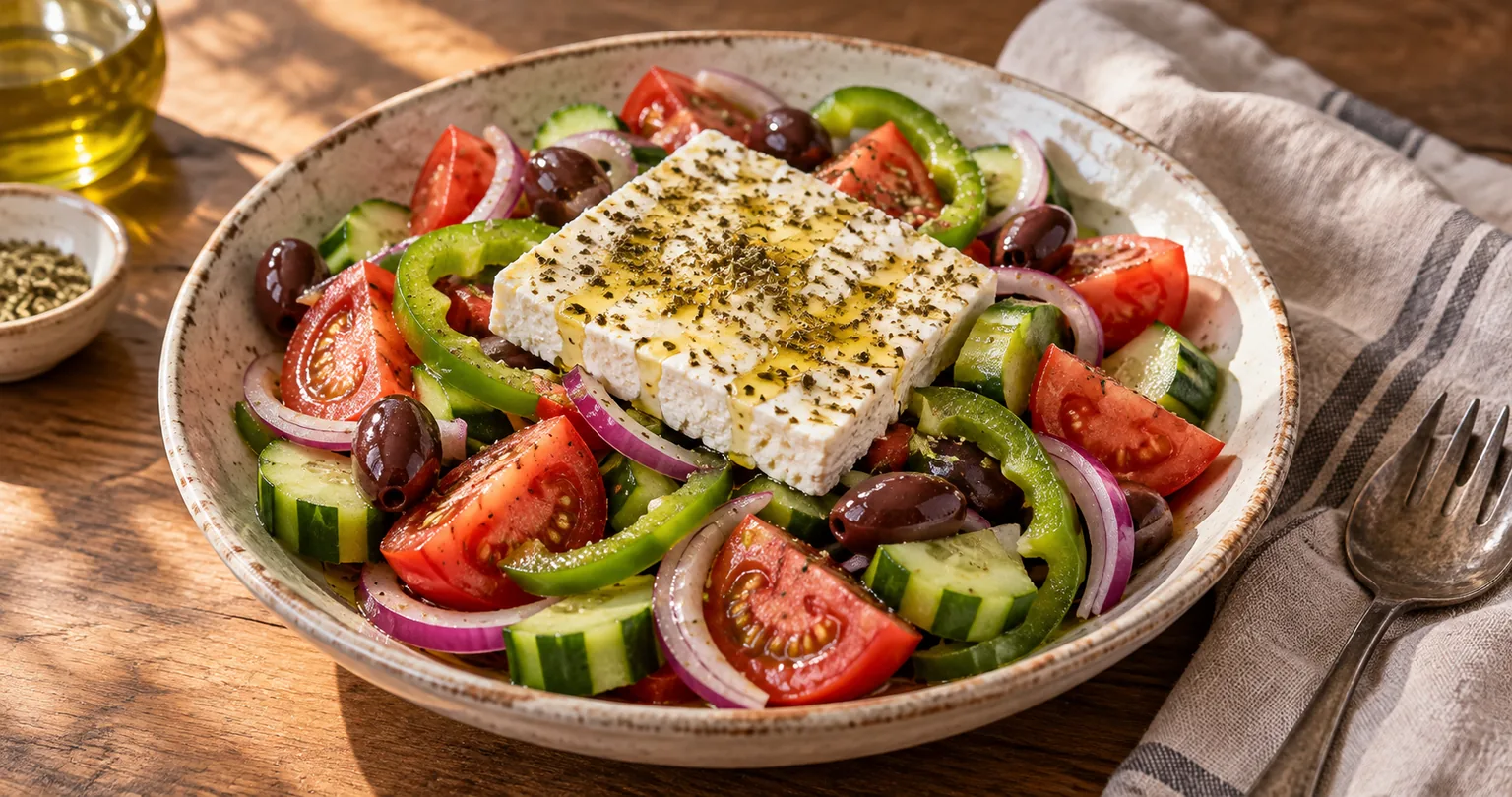
Greek salad
- Yield
- 4 servings
Greek salad is ripe tomatoes, cucumber, onion, pepper and olives under a whole slab of feta, dressed with olive oil, a little vinegar and oregano. It has no lettuce and no whisked dressing, because the tomatoes make their own. It teaches you how salting and cutting shape a raw salad.
IngredientsTips are one tap away.
Ingredients
Batches and reset
4 servings · US measures · 1 batch
Batching
Assemble one batch in each serving bowl about 12 inches across; for a larger yield, use a second bowl. Salting, soaking and tasting cues do not multiply with ingredient quantities.
Original recipe: 4 servings.
The optional capers and crusty bread, black pepper and any extra salt or vinegar are excluded from the base nutrition scenario. Fine salt is the selected salt. Nutrition is incomplete because no Kalamata olive record is established.
Before you start
- Read through the recipe before you start. Gather the serving bowl, small bowl of ice water, knife, cutting board, peeler, strainer, paper towels and the measured ingredients.
Directions
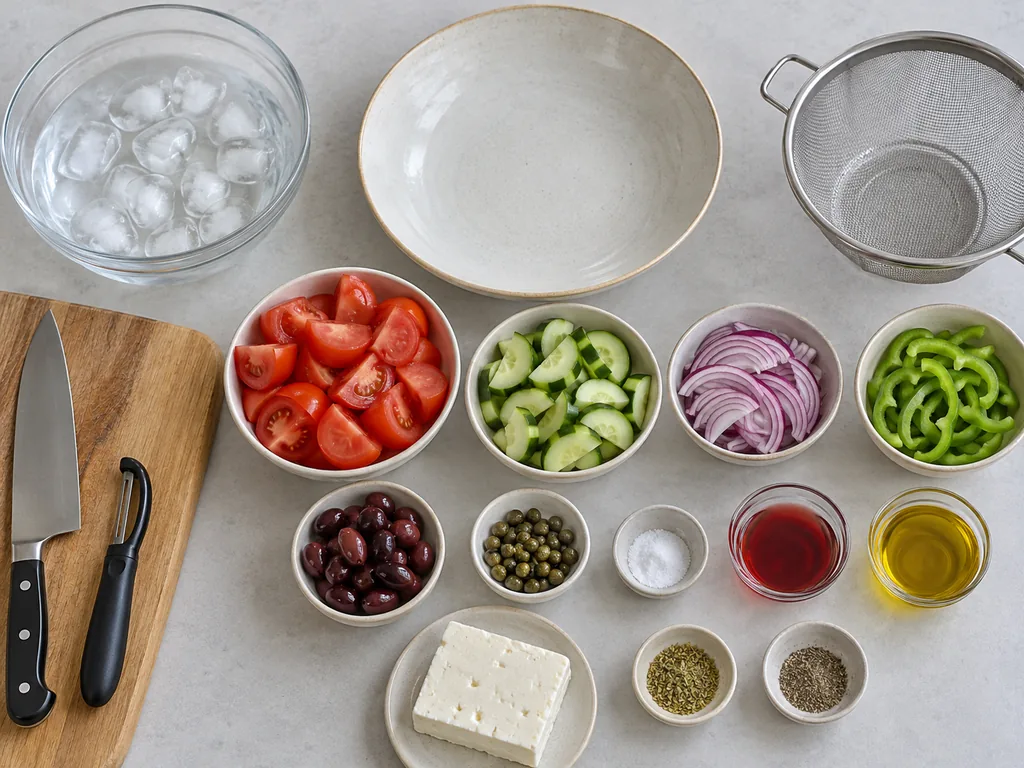
Read and gather
For the whole recipe
Read through the recipe and gather the equipment. Use the ingredient lines to prepare and measure everything; rinse and dry the vegetables before cutting them, and fill the small bowl with ice water. Everything is prepared and measured before you start assembling.
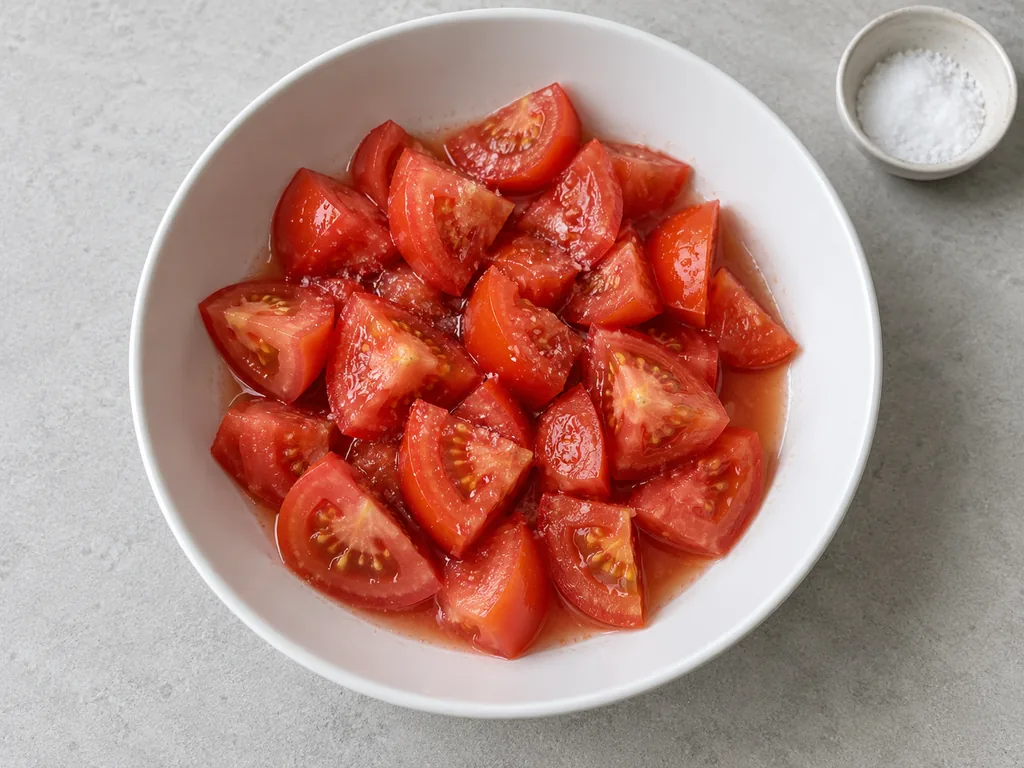
Salt the tomatoes
For each bowl of salad
Salt the tomatoes in the serving bowl: put in about 1 1/2 lb ripe tomatoes and sprinkle them with 1/4 tsp fine salt. Leave them to sit while the onion soaks, until juice starts to pool in the bottom of the bowl.
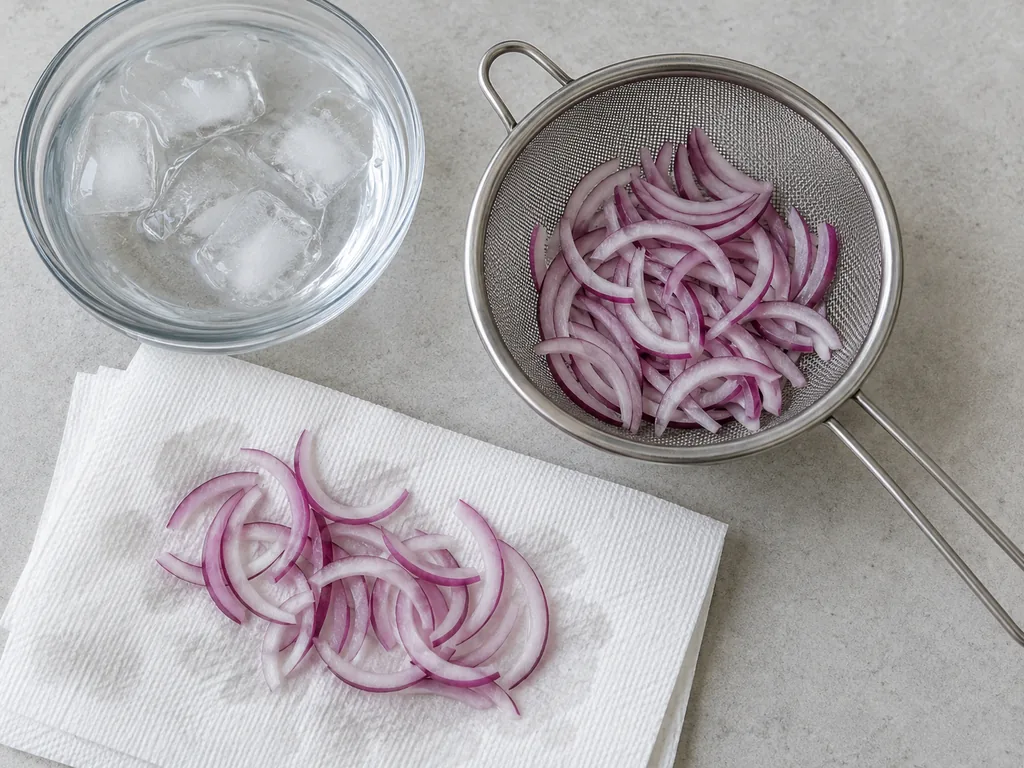
Soak the onion in ice water
For each bowl of salad
Soak about 2 oz red onion in the ice water, separating the slices with your fingers, until a slice tastes sweet and crisp rather than hot and sharp, about 10 minutes. Drain it in the strainer and pat it dry with paper towels.
Add the vegetables and dress the salad
For each bowl of salad
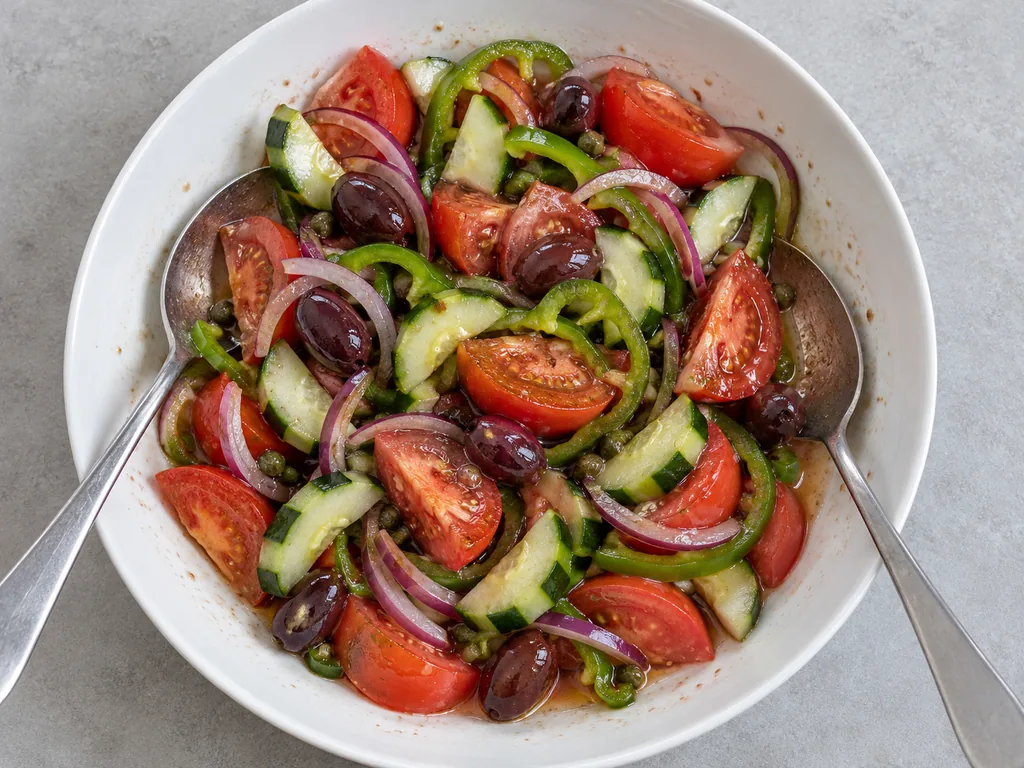
Add the onion, the cucumber, the bell pepper, about 1/2 cup Kalamata olives and 1 tbsp capers, if using, to the tomatoes. Drizzle with 1 tbsp red wine vinegar and then 4 tbsp extra-virgin olive oil, and toss gently with your hands or two large spoons until everything is glossy.
Taste and adjust
For each bowl of salad
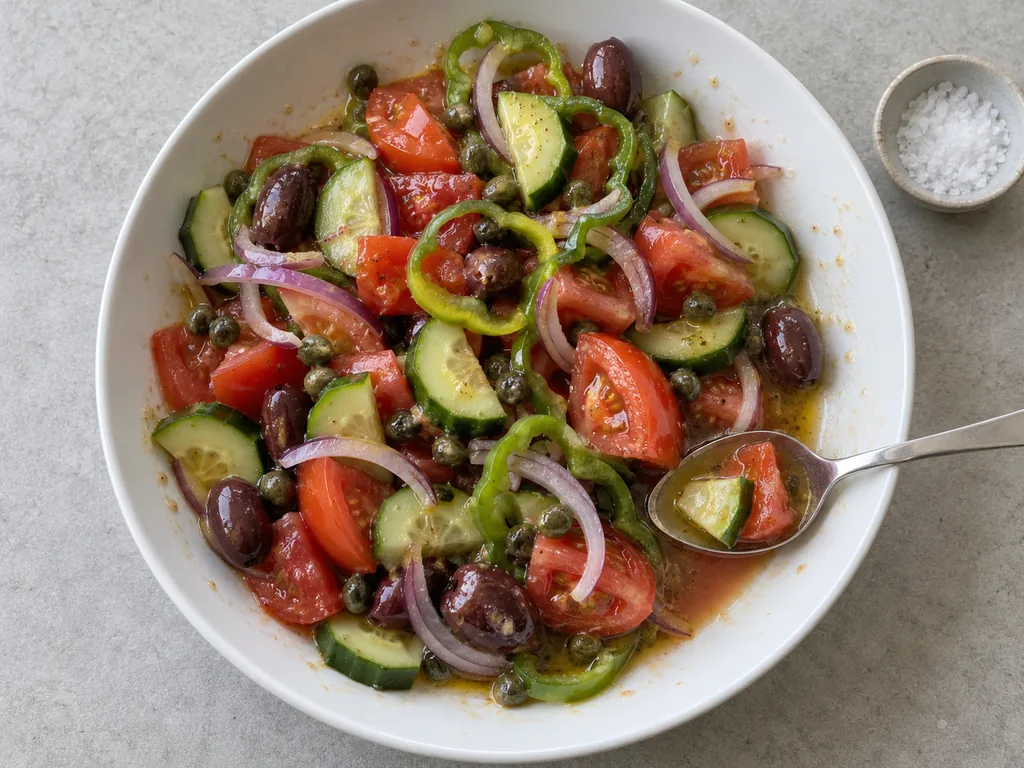
Taste a piece of tomato and cucumber with juice from the bottom of the bowl. Aim for bright, juicy and salty-sweet, a little peppery and a little sharp. If it tastes flat, add fine salt to taste and turn the salad once. If it is still dull after salting, add red wine vinegar to taste, a few drops at a time. The salad tastes bright and well seasoned.
Set the feta on top and season it
For each bowl of salad
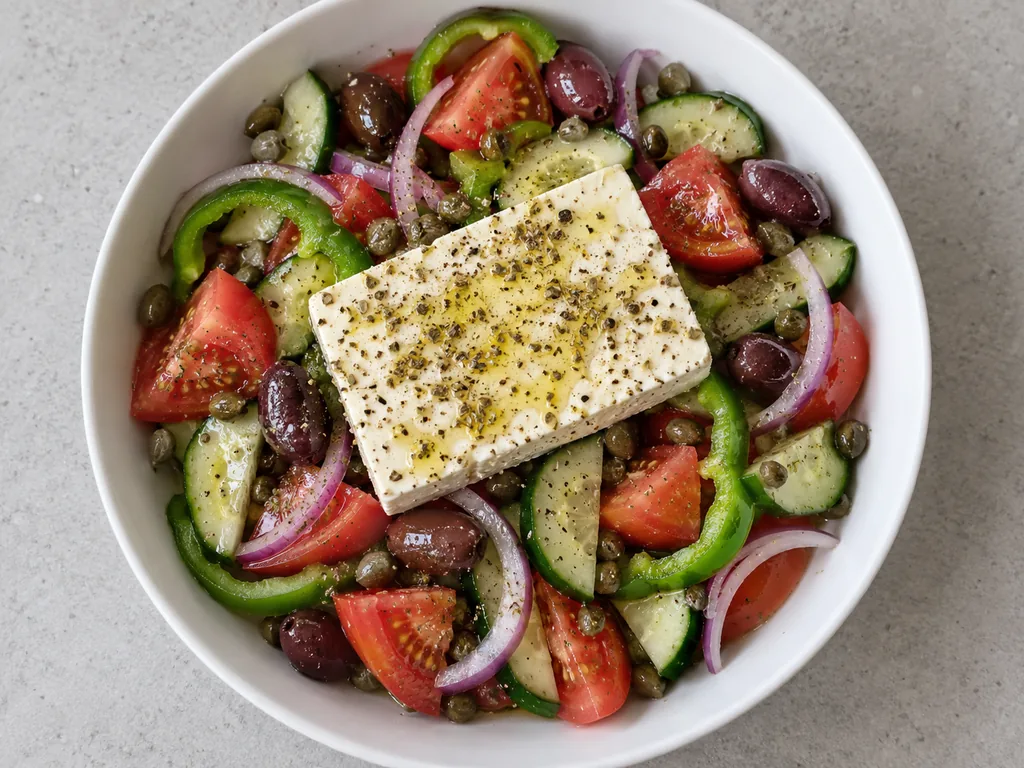
Set the about 8 oz feta on the salad as one slab. Rub 1 tsp dried oregano between your palms over the feta and vegetables, drizzle 1 tbsp extra-virgin olive oil over the feta and finish with black pepper to taste. The feta sits on top, oiled and seasoned.
Bring to the table and serve
For the whole recipe
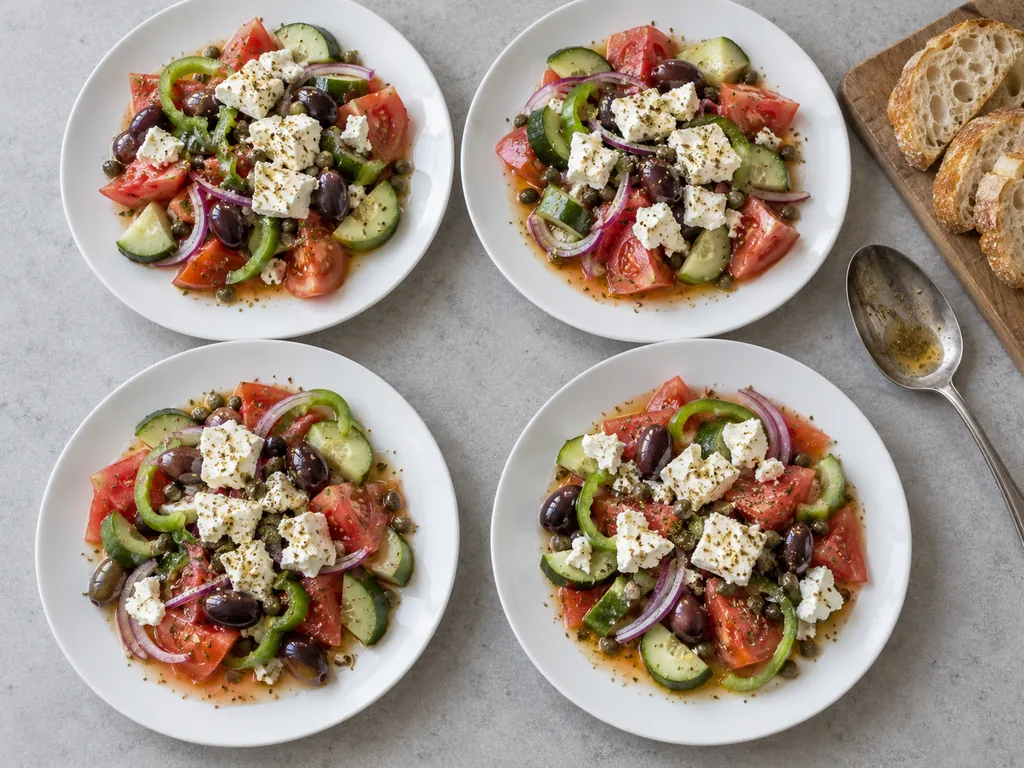
Bring the bowl to the table and break the feta into chunks with a fork. Divide the salad among plates to make 4 servings, spooning some of the juices over each, and serve with crusty bread, if using, for mopping up the juice. Warn everyone about pits if your olives are whole. Refrigerate leftovers within two hours (one hour above 90°F). The salad is served with its juices.
About this recipe
Research preview: these details come from our sourced research and haven't been reviewed by our chef yet.
Why it works
Salting the tomatoes first draws out juice that becomes the dressing, and a short soak in ice water takes the harsh bite off the onion. Big, even pieces put a bit of everything in each forkful, and rubbing dried oregano between your palms releases its aroma over the feta.
Associated with
Greek and Cypriot
In Greek it is horiatiki, the village salad: tomatoes, cucumber, onion, feta and olives dressed with salt, oregano and olive oil, with no lettuce and the feta often laid on as a slab. It reflects what Greek farmers had to hand; lettuce versions are an adaptation abroad.
Taste
- Sweet
- Sour
- Salty
- Bitter
- Savory
- Heat
Salted tomatoes give up their juice, which becomes the dressing with the olive oil and a little vinegar., Feta and olives bring salt; raw onion and green pepper add bite. · juicy tomato, crisp cucumber and pepper, creamy, crumbly feta, meaty olives · room
Skill level
Easy
No cooking. The cues are tasting the tomato juices and soaking the onion until it tastes sweet and crisp.
Allergens
Contains: milk. The optional bread contains wheat.
Check the red wine vinegar label for sulfites and the bread label for egg and sesame.
Diets
Vegetarian: Depends on what you buy Pescatarian: Depends on what you buy Vegan: Doesn't fit as written Dairy: See the allergen lines Egg: See the allergen lines Gluten: See the allergen lines
Occasions
Lenten abstinence days (Ash Wednesday and the Fridays of Lent)
No meat is listed.
Orthodox Great Lent
Leave out the feta, and the olive oil on strict weekdays; olives and vegetables are allowed.
Serving and keeping
Best served: Right after the final taste, with the feta broken into chunks at the table From one bowl or on plates with the juices spooned over, with crusty bread for mopping up
Make ahead: Salt and dress the salad when serving.
Storage: Refrigerate leftovers within 2 hours (1 hour above 90 °F / 32 °C), at 40 °F (4 °C) or below. The vegetables soften.
Leftovers: Leftover vegetables soften in the juices.
Food safety
- Rinse and dry the vegetables before cutting, and scrub the cucumber with a clean brush.
- Young children, older adults, pregnant people and anyone with a weakened immune system should use feta made with pasteurized milk.
- Whole olives may contain pits; warn everyone before serving.
- Refrigerate leftovers within 2 hours (1 hour above 90 °F / 32 °C).
We make no statement about cross-contact in your kitchen or in packaged ingredients. Check the feta, vinegar and bread labels.
Nutrition notes
Most of the sodium comes from the feta, olives and capers. Using less of them and skipping the extra salt on the tomatoes keeps it lower.
Most of the saturated fat comes from the feta; the olive oil and olives carry most of the other fat.
The tomatoes, cucumber and green pepper bring vitamin C and fiber; the feta brings calcium and protein.
Swap notes
feta · vegetarian
Use: feta labelled with microbial rennet
What changes: No change to taste.
Not a swap: Mild, rubbery cheeses such as mozzarella or Monterey Jack, which bring no salt or tang.
feta · halal.general
Use: halal-certified or microbial-rennet feta
What changes: Use fresh lemon juice in place of the red wine vinegar if you avoid wine vinegar, and check the olive brine.
Not a swap: A feta whose label says only "enzymes" or animal rennet.
feta · vegan
What changes: Leave out the feta, as in the Lenten style; the salad is sharper and brighter, without the creamy salt.; Choose a bread made without milk, butter, egg or honey.
Not a swap: An enriched bread made with milk, butter, egg or honey alongside.
feta · orthodox.fast_strict
What changes: Leave out the feta.; On strict weekdays also leave out the olive oil and dress with vinegar, salt and oregano only; this is the traditional Lenten form.
Not a swap: Any cheese, which is dairy.
feta · young children, older adults, pregnant people or a weakened immune system
Use: feta made with pasteurized milk
What changes: No change to taste.
Not a swap: Feta made with raw (unpasteurized) milk.
red onion · buddhist.five_pungent
What changes: Leave out the onion; the salad has less bite.
Not a swap: Shallot or a sweet onion, which are onions too.
red wine vinegar · halal.general
Use: fresh lemon juice
What changes: Brighter than vinegar.
Not a swap: Balsamic vinegar, which turns the juices brown and sweet and is also made from grapes.
ripe tomatoes · tomatoes out of season
Use: ripe cherry or grape tomatoes, halved, by the same weight
What changes: There is less juice in the bowl, so add another spoonful of oil.
Not a swap: Pale, hard winter tomatoes, which stay dry and flavorless even after salting.
Kalamata olives · no Kalamata olives
Use: other brine-cured black olives, or green Greek olives
What changes: Green olives are firmer and sharper.
Not a swap: Mild California-style ripe olives, which have almost no brine flavor.
dried oregano · no dried oregano
Use: finely chopped fresh oregano, about three times the volume
What changes: Fresh oregano is milder and greener.
Not a swap: Dried basil in the same amount, which pushes the salad toward Italy.
crusty bread · passover.ashkenazi
What changes: Serve without the bread.; Use kosher-for-Passover feta, olives, vinegar and oil.
Not a swap: Leavened bread, which is chametz.
These notes don't change the amounts, allergens or nutrition shown for this recipe.
For your food tracker
Fields for MyFitnessPal and other trackers
- Recipe url
- https://isthebestrecipe.com/salads/greek-salad
- Name
- Greek salad
- Servings
- 4
- Recipe yield
- 4 servings
- Recipe ingredient
- about 1 1/2 lb ripe tomatoes about 4 medium, cored and cut into bite-size wedges, 1/4 tsp fine salt, about 2 oz red onion about half a small onion, sliced into thin half-moons, 1 whole large cucumber peeled in stripes, halved lengthwise and cut into 1/2-inch half-moons, 1 whole small green bell pepper seeded and sliced into thin rings, about 1/2 cup Kalamata olives pitted or whole (whole ones have pits), 1 tbsp red wine vinegar, 5 tbsp extra-virgin olive oil, about 8 oz feta one block in brine, drained and patted dry, 1 tsp dried oregano Greek if you can find it, to taste black pepper freshly ground
- Copy action wording
- Copy recipe and estimated nutrition
Sources
- FoodData Central: Cheese, feta (FDC ID 173420) (USDA Agricultural Research Service, FoodData Central, 2019-04-01)
- FoodData Central: Olives, ripe, canned (small-extra large) (FDC ID 169094) (USDA Agricultural Research Service, FoodData Central, 2019-04-01)
- Food Allergies (major food allergens under FALCPA and the FASTER Act) (U.S. Food and Drug Administration, 2026-03-11)
- Regulation (EU) No 1169/2011, Annex II: Substances or products causing allergies or intolerances (legislation.gov.uk (The National Archives) copy of the EU regulation text, 2014-02-19)
- Sulphites: One of the priority food allergens (Health Canada)
- Regulation (EU) No 1169/2011, Annex II: substances or products causing allergies or intolerances (text as adopted) (European Parliament and Council; text read from legislation.gov.uk (The National Archives) copy of the adopted EU text, 2011-10-25)
- Leftovers and Food Safety (USDA Food Safety and Inspection Service, 2020-07-31)
- FoodKeeper data (foodkeeper.json) (USDA Food Safety and Inspection Service (with Cornell University and FMI))
- People at Risk: Pregnant Women (FoodSafety.gov (HHS/USDA/FDA/CDC), 2026-10-05)
- Kalamata olive (Wikipedia)
- FoodData Central: Onions, red, raw (FDC ID 790577) (USDA Agricultural Research Service, FoodData Central, 2020-04-01)
- FoodData Central: Tomatoes, red, ripe, raw, year round average (FDC ID 170457) (USDA Agricultural Research Service, FoodData Central, 2019-04-01)
- FoodData Central: Cucumber, with peel, raw (FDC ID 168409) (USDA Agricultural Research Service, FoodData Central, 2019-04-01)
- FoodData Central: Peppers, sweet, green, raw (FDC ID 170427) (USDA Agricultural Research Service, FoodData Central, 2019-04-01)
- FoodData Central: Capers, canned (FDC ID 172238) (USDA Agricultural Research Service, FoodData Central, 2019-04-01)
- FoodData Central: Vinegar, red wine (FDC ID 172240) (USDA Agricultural Research Service, FoodData Central, 2019-04-01)
- FoodData Central: Oil, olive, salad or cooking (FDC ID 171413) (USDA Agricultural Research Service, FoodData Central, 2019-04-01)
- FoodData Central: Spices, oregano, dried (FDC ID 171328) (USDA Agricultural Research Service, FoodData Central, 2019-04-01)
- Daily Value on the Nutrition and Supplement Facts Labels (U.S. Food and Drug Administration)
- 21 CFR 101.54 Nutrient content claims for 'good source,' 'high,' 'more' (Legal Information Institute, Cornell Law School (reproducing the eCFR))
- 21 CFR 101.61 Nutrient content claims for the sodium content of foods (Legal Information Institute, Cornell Law School (reproducing the eCFR))
Make it the best
Copy this recipe and make it your own. Change amounts, swap ingredients, rewrite steps. The original stays as it is.
Nutrition Values
Nutrition estimates aren’t available for this recipe yet.
Your notes
Kept on this device.Return: https://isthebestrecipe.com/salads/greek-salad