
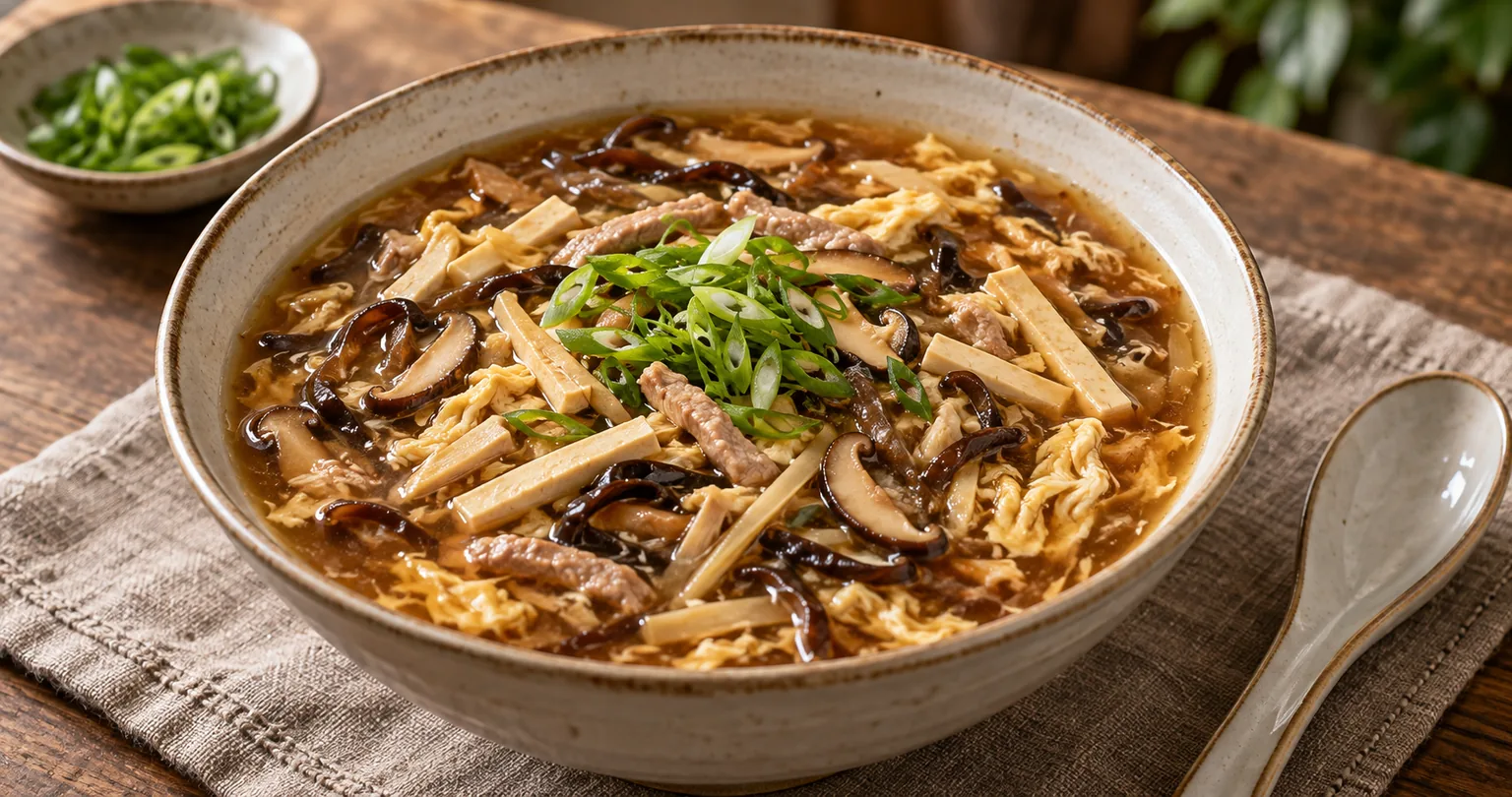
Hot and sour soup
- Yield
- 4 servings
This soup is a lesson in balance and timing. Vinegar brings the sour, white pepper brings the heat, and a cornstarch slurry gives it the silky body that holds up every strand of mushroom, tofu and egg. Almost everything happens in the last five minutes, so the whole trick is having it lined up.
IngredientsTips are one tap away.
Ingredients
Batches and reset
4 servings · US measures · 1 batch
Batching
Cook one base batch in each 4- to 5-quart saucepan; for a larger yield, use a second pot or cook a second batch. Simmering, thickening and seasoning follow the same cues; cooking times do not multiply with ingredient quantities.
Original recipe: 4 servings.
The wood ear mushrooms, chili oil and extra salt, vinegar and white pepper are left out of the nutrition estimate. Low-sodium chicken broth is the selected broth, so this edition is not vegetarian. Nutrition is incomplete: the shiitake stems are thrown away and their share is not established, and the Chinkiang and rice vinegars have no retained USDA composition record.
Before you start
- Read through the recipe before the pot goes on. Gather the bowls, plate, lined strainer, pot, fork, ladle, thermometer and measured ingredients. If your kosher salt is the dense, fine-grained kind, use about half as much.
Directions
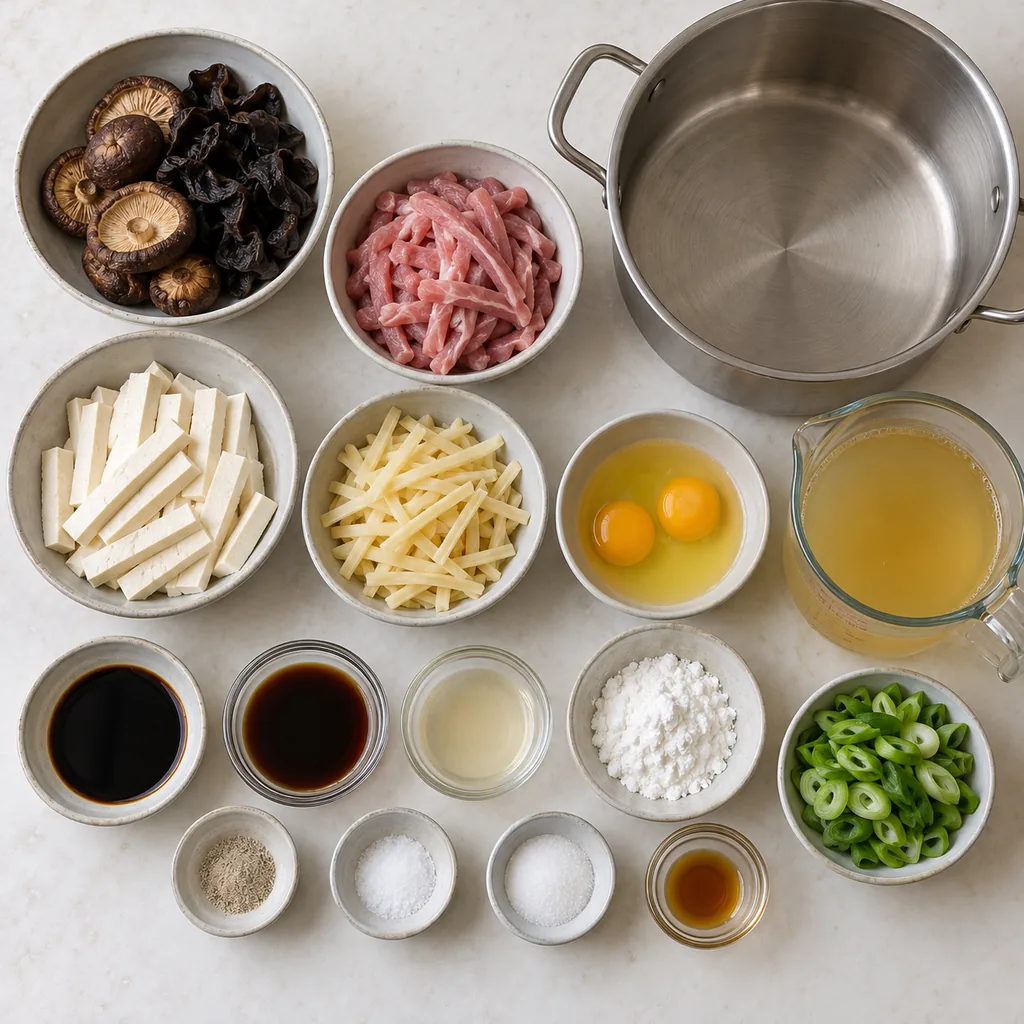
Read through and gather
For the whole recipe
Read through the recipe, then gather the equipment and use the ingredient lines to prepare and measure everything. Almost everything happens in the final few minutes of cooking, so set each prepared ingredient in its own small bowl near the stove. Everything is prepared and measured before the pot goes on the heat.
Soak the dried mushrooms
For each pot of soup
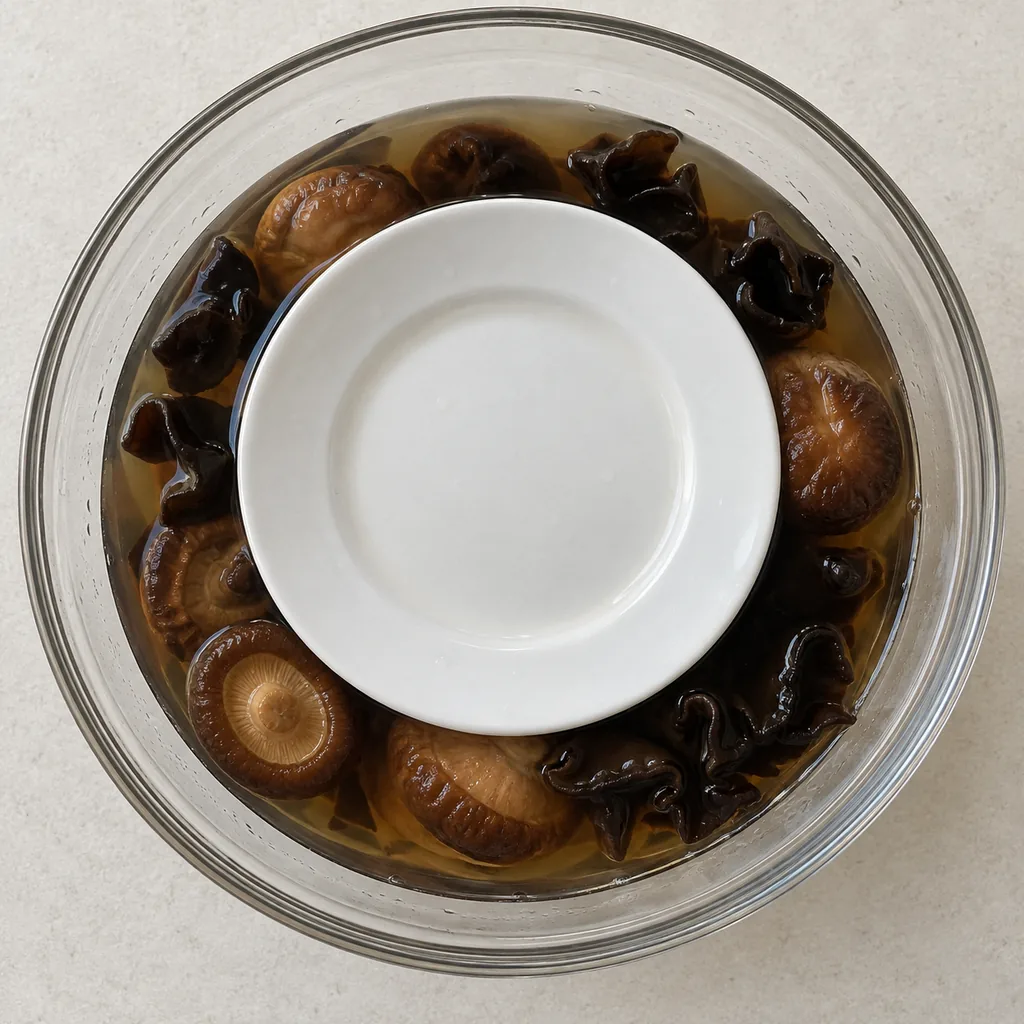
Soak the dried shiitake mushrooms and 2 tbsp dried wood ear mushroom pieces, if using, in 2 cups hot water in the heatproof bowl, with the small plate on top to keep them under, until soft all the way through, about 20 minutes.
Coat the pork and mix the slurry
For each pot of soup
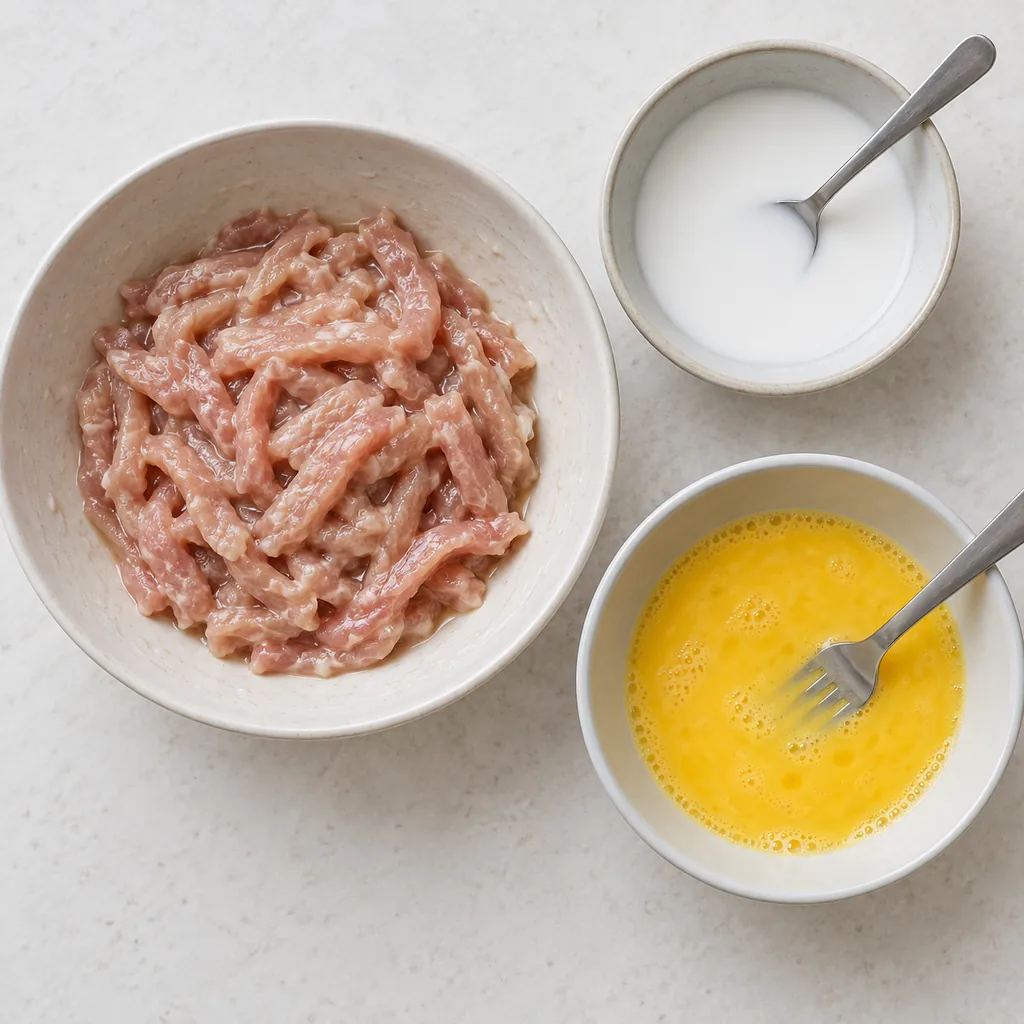
Coat the pork while the mushrooms soak: toss 4 oz boneless pork loin with 1 tsp soy sauce and 1 tsp cornstarch. In a small bowl, stir 3 tbsp cornstarch into 1/4 cup cold water for the slurry, and beat the eggs in another bowl. The pork is evenly coated and the slurry is smooth.
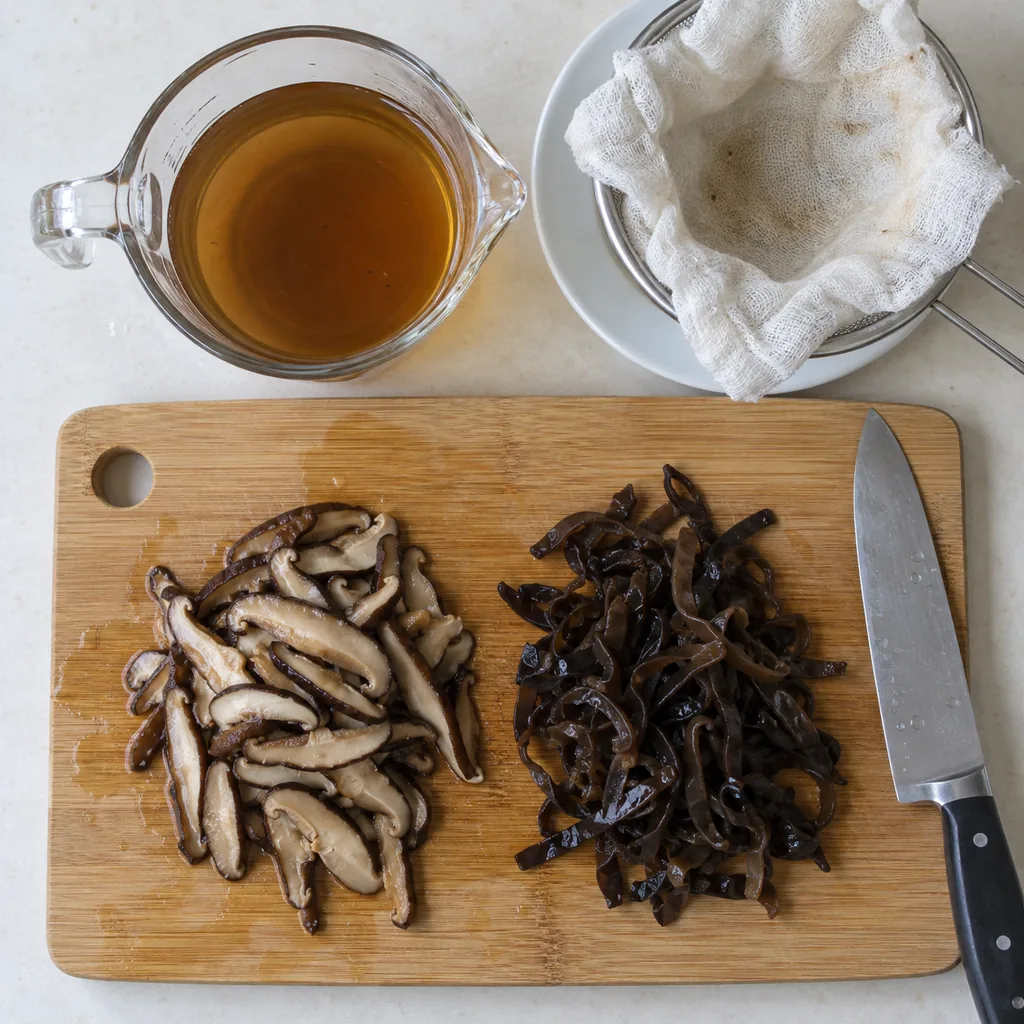
Lift out and slice the mushrooms
For each pot of soup
Lift out the mushrooms, squeezing their liquid back into the bowl. Cut off and throw away the shiitake stems, slice the caps thin and cut the wood ear into strips. Strain 1 cup of the soaking liquid through the lined strainer, leaving the grit behind. The strained liquid is clear.
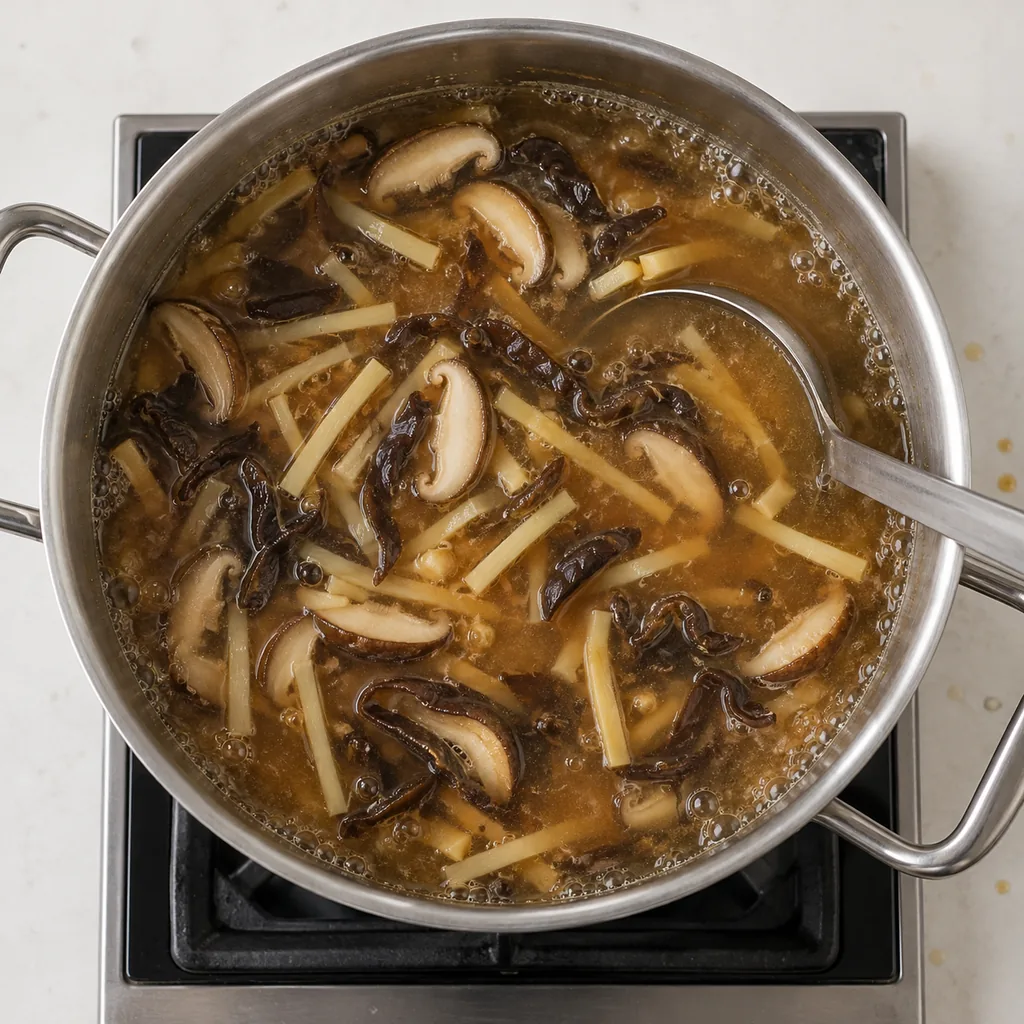
Combine and simmer the seasoned broth
For each pot of soup
Combine 5 cups low-sodium chicken broth, the strained mushroom liquid, the sliced mushrooms, 1 cup canned sliced bamboo shoots, 2 tbsp soy sauce, 1 tsp sugar and 1/2 tsp flaky kosher salt in a 4- to 5-quart saucepan or soup pot. Bring to a simmer over medium-high heat, then turn to medium-low heat and simmer until the mushrooms taste seasoned through, about 5 minutes.
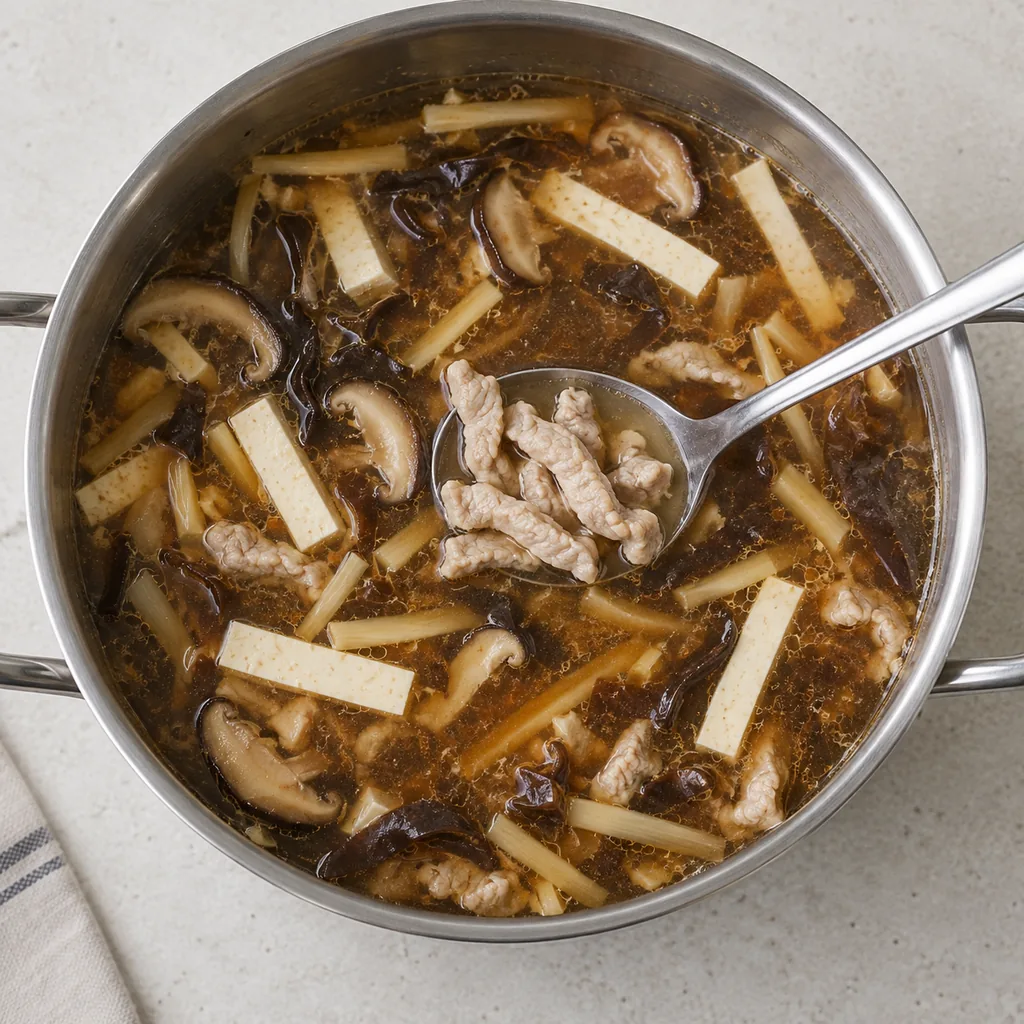
Add the pork, then warm the tofu
For each pot of soup
Add the coated pork a few strips at a time over medium-low heat, stirring the strips apart. Simmer until the pork is opaque and firm with no pink and a bundle of strips reads 145°F (63°C) on an instant-read thermometer, about 2 minutes. Slide in 7 oz firm tofu and simmer until it is hot through. The USDA endpoint for whole cuts of pork includes a three-minute rest, which the pork gets in the hot soup as you finish.
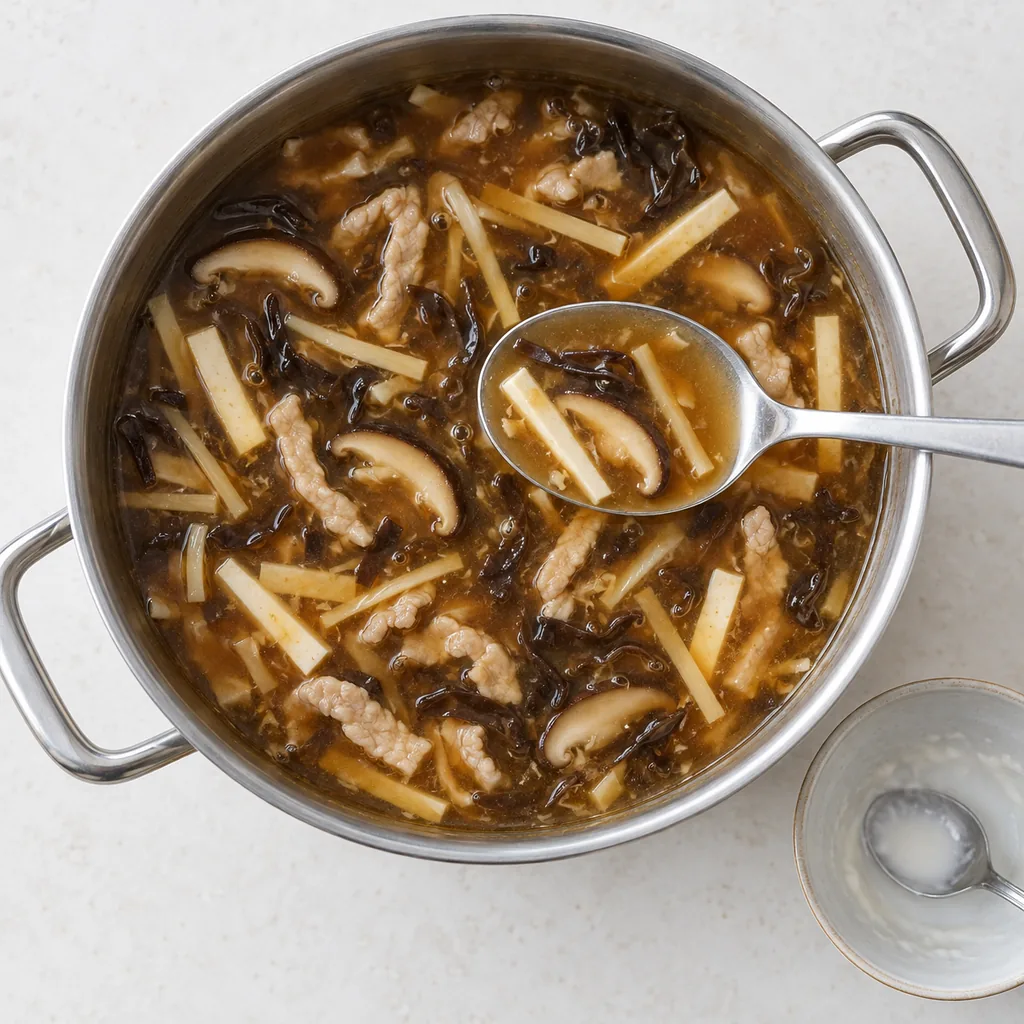
Stir in the slurry
For each pot of soup
Stir the slurry again, since the starch settles, and pour it into the soup while stirring. Keep stirring at a simmer over medium-low heat until the soup turns glossy and lightly coats the spoon, about 1 minute.
Turn the heat down and add the egg ribbons
For each pot of soup
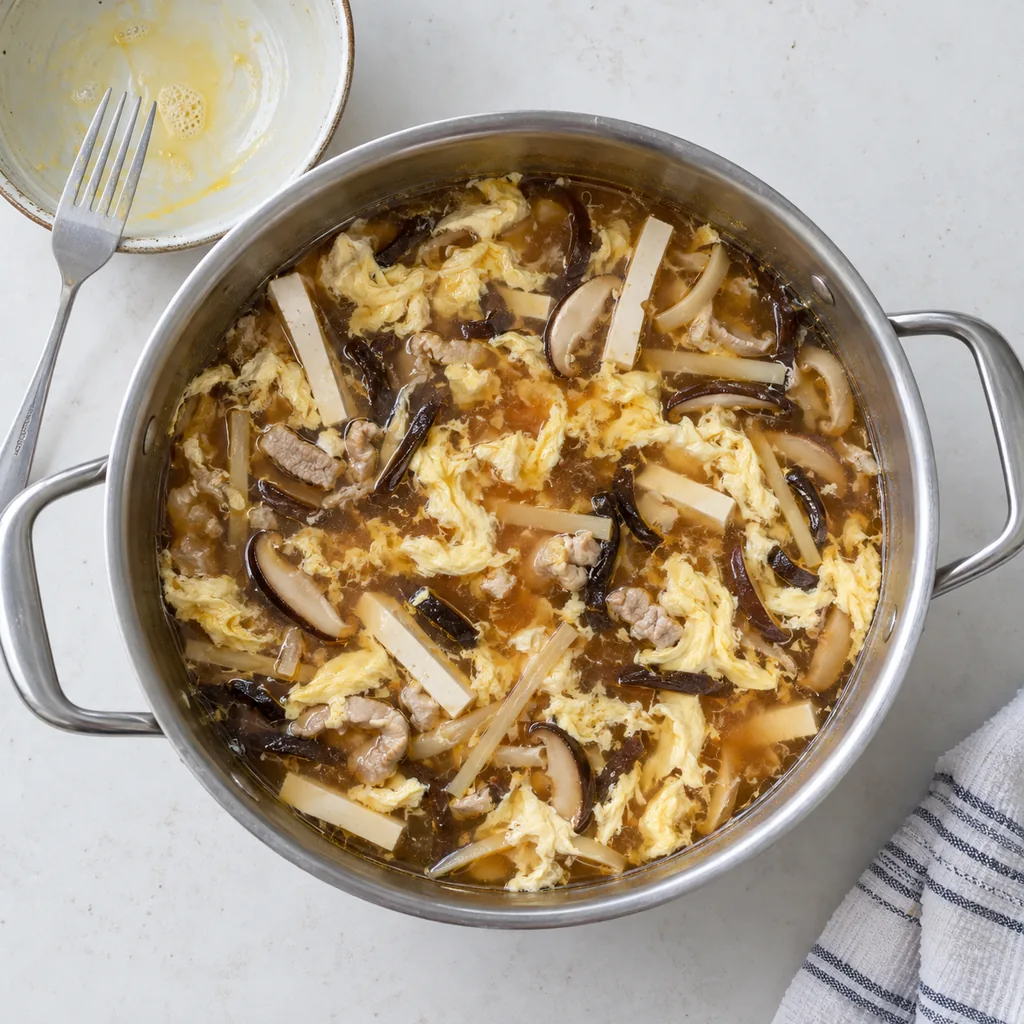
Turn the heat down to low heat so the soup barely bubbles, and stir it slowly in one direction. Stop stirring and pour the beaten eggs in a thin stream along the prongs of a fork held over the pot. Wait until the ribbons float up and set firm, with no runny egg, about 30 seconds, then stir gently.
Turn off the heat and add the vinegars
For each pot of soup
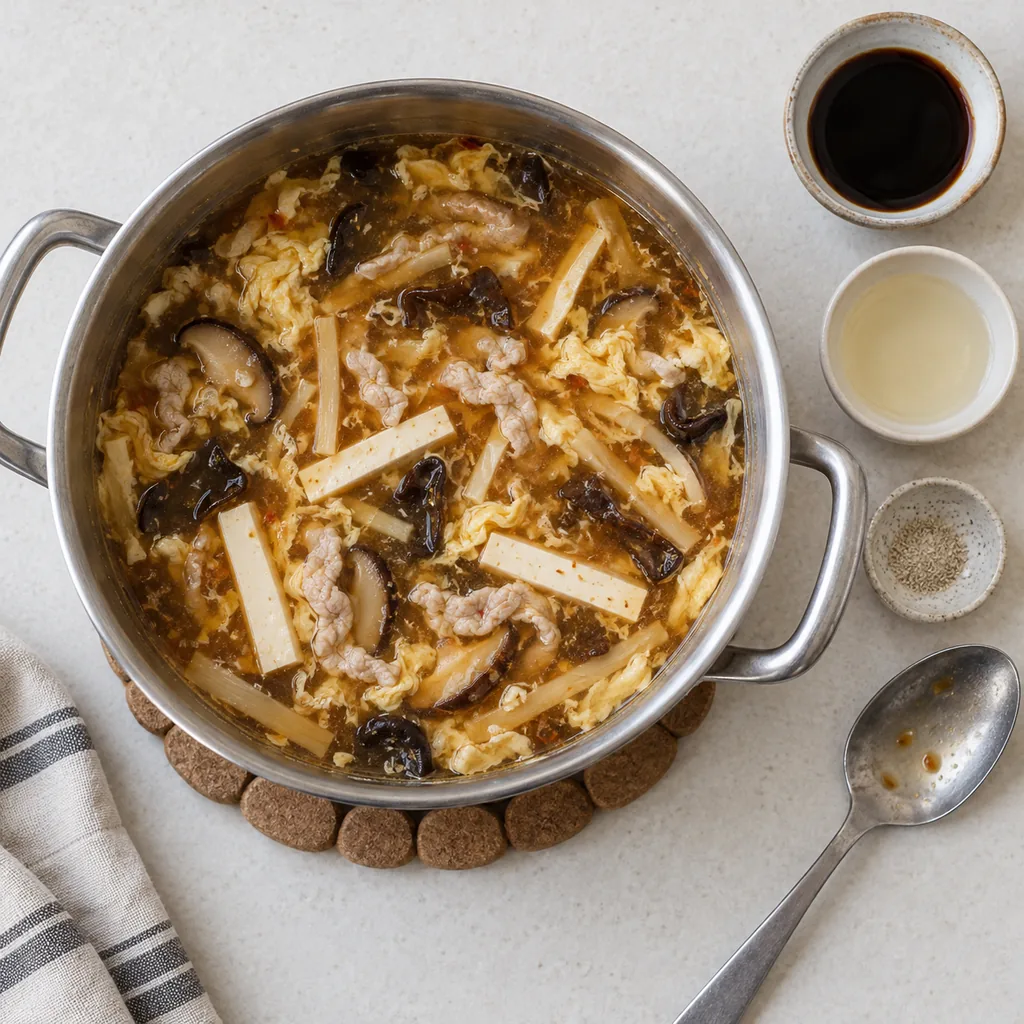
Turn off the heat; on an electric burner, also slide the pot off. Once the bubbling stops, stir in 3 tbsp Chinkiang black vinegar, 2 tbsp unseasoned rice vinegar, 1 tsp ground white pepper and 1 tsp toasted sesame oil. The soup smells sharply sour and peppery.
Taste and adjust the balance
For each pot of soup
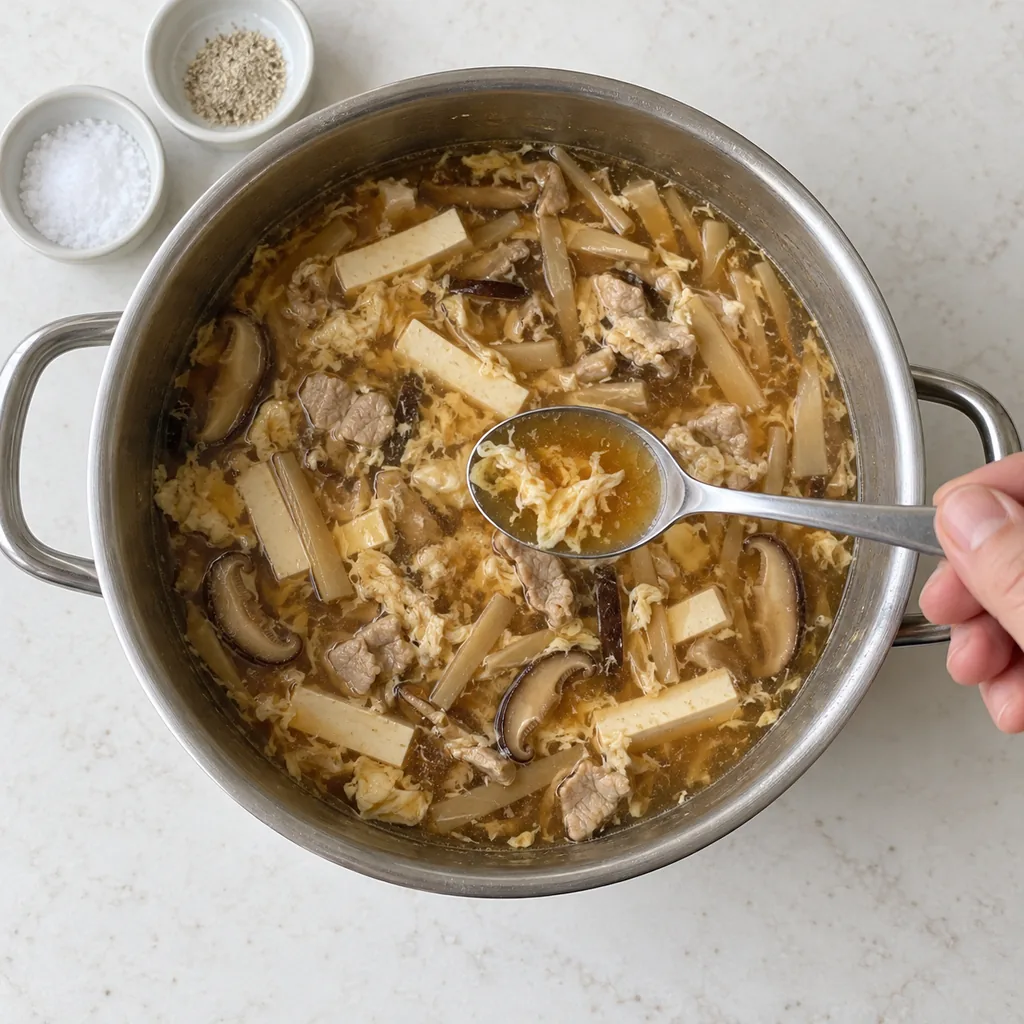
Taste the soup. Aim for sour first, then warm pepper at the back of the throat, savory underneath and barely sweet. If it tastes flat, add flaky kosher salt to taste; if it is not sour enough, add Chinkiang black vinegar to taste; if it is not hot enough, add ground white pepper to taste. The soup tastes sour, hot and savory.
Ladle and serve
For the whole recipe
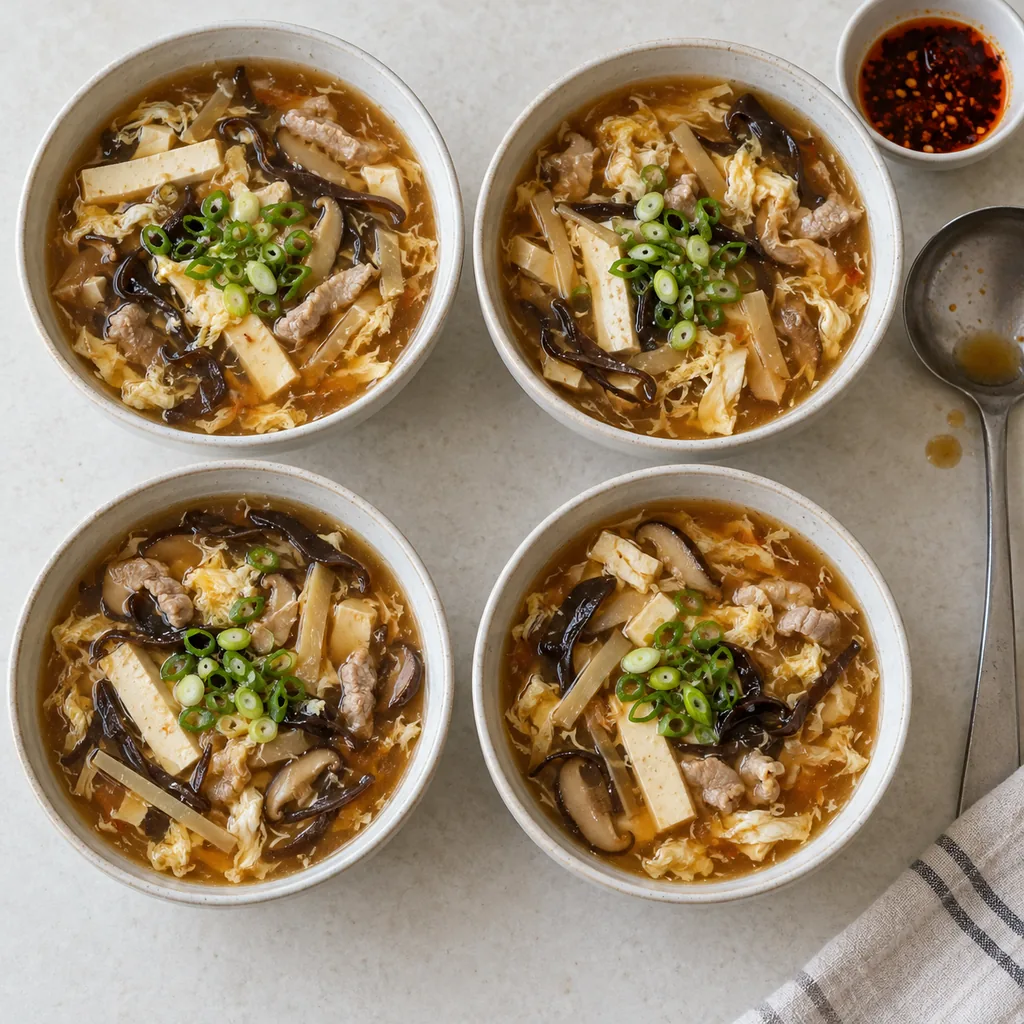
Ladle the soup into bowls to make 4 servings and top them with the green onions. Set out chili oil to taste at the table, if you like. Refrigerate leftovers promptly and reheat them to 165°F (74°C), checked with an instant-read thermometer. The soup is portioned and garnished.
About this recipe
Research preview: these details come from our sourced research and haven't been reviewed by our chef yet.
Why it works
Soaked dried mushrooms and their strained liquid deepen the broth. A light soy-and-cornstarch coat keeps the thin pork tender, the slurry goes in before the egg so the thickened soup holds up the ribbons, and the vinegar and pepper go in last, off the heat, where they stay bright.
Associated with
Chinese and Chinese American
Beijing-style hot and sour soup is soured with black vinegar and heated with white pepper; the cuisine of Beijing claims it, and it is related to the peppery hulatang of Henan. The American Chinese restaurant version is thickened with cornstarch and adds wood ear, bamboo shoots and egg.
Taste
- Sweet
- Sour
- Salty
- Bitter
- Savory
- Heat
Sour first from black and rice vinegar., Warm white-pepper heat at the back of the throat, savory underneath, barely sweet. · silky, lightly thickened broth, shreds of mushroom and bamboo shoot, soft tofu and egg ribbons · hot
Skill level
Some practice
Most of the cooking happens in the last five minutes, so everything has to be lined up; the slurry and egg-ribbon timing take a little practice.
Allergens
Contains: egg, wheat, soy, sesame.
Check the black vinegar for wheat, the dried shiitake for sulfites, the broth label, and the chili oil (if served) for shrimp, sesame and soy.
Diets
Vegetarian: Doesn't fit as written Vegan: Doesn't fit as written Pescatarian: Doesn't fit as written Dairy: See the allergen lines Egg: See the allergen lines Gluten: See the allergen lines
Occasions
Serving and keeping
Best served: Right after the vinegar and pepper go in In bowls topped with sliced green onion, with chili oil at the table
Make ahead: Add the pork, tofu, slurry, egg and vinegar when you serve, since almost everything happens in the last five minutes.
Storage: Refrigerate within 2 hours (1 hour above 90 °F / 32 °C), in shallow containers. It can be frozen, but the egg ribbons and tofu turn spongy.
Leftovers: The soup thickens as it stands; loosen it with a little broth when you reheat.
Food safety
- Cook the pork strips to 145 °F (63 °C), checked on a bundle with an instant-read thermometer, then let them rest 3 minutes in the hot soup.
- Let the egg ribbons set until firm before stirring.
- Keep raw pork and its board and knife away from ready-to-eat foods, and wash hands after handling it.
- Refrigerate leftovers within 2 hours, or 1 hour above 90 °F (32 °C), and reheat to 165 °F (74 °C).
We make no statement about cross-contact in your kitchen or in packaged ingredients. Check the black vinegar, broth, dried mushroom and chili oil labels.
Nutrition notes
Soy sauce and added salt carry most of the sodium. Low-sodium soy sauce, and salting only at the end after tasting, keep it lower; the vinegar and pepper carry the flavor.
Swap notes
boneless pork loin · vegetarian
Use: A little more firm tofu
What changes: Use vegetable broth in place of the chicken broth.; Lighter and more mushroom-forward; expect to add a little more salt and soy sauce at the end.
Not a swap: Thick chunks of pork shoulder, which stay chewy in the short simmer.
low-sodium chicken broth · vegetarian
Use: Vegetable broth, same amount
What changes: Lighter; season a little more at the end.
Not a swap: Beef broth, which takes over the mushrooms.
boneless pork loin · halal
Use: Halal chicken thigh strips, same weight
What changes: Cook to 165 °F (74 °C).; Use halal-certified chicken broth.; Scholars differ on the alcohol formed in brewed soy sauce.
Not a swap: Pork broth, which halal practice also forbids.
soy sauce
Use: Low-sodium soy sauce, same amount
What changes: Leave out the starting salt and season at the end.; Slightly flatter; the vinegar and pepper carry it.
Not a swap: Seasoned rice vinegar, whose sugar and salt throw the balance off.
These notes don't change the amounts, allergens or nutrition shown for this recipe.
For your food tracker
Fields for MyFitnessPal and other trackers
- Recipe url
- https://isthebestrecipe.com/soups/hot-and-sour-soup
- Name
- Hot and sour soup
- Servings
- 4
- Recipe yield
- 4 servings
- Recipe ingredient
- 6 whole dried shiitake mushrooms, 2 cups hot water for soaking, 4 oz boneless pork loin cut into matchsticks about 1/8 inch thick, 1 tsp soy sauce for the pork, 1 tsp cornstarch for the pork, 3 tbsp cornstarch for the slurry, 1/4 cup cold water for the slurry, 2 whole large eggs beaten, 5 cups low-sodium chicken broth, 1 cup canned sliced bamboo shoots drained, rinsed and cut into matchsticks, 2 tbsp soy sauce for the soup, 1 tsp sugar, 1/2 tsp flaky kosher salt, 7 oz firm tofu cut into strips 1/4 inch thick and 2 inches long, 3 tbsp Chinkiang black vinegar, 2 tbsp unseasoned rice vinegar, 1 tsp ground white pepper, 1 tsp toasted sesame oil, 2 whole green onions thinly sliced
- Copy action wording
- Copy recipe and estimated nutrition
Sources
- Hot and sour soup (Wikipedia, 2026-09-30)
- Zhenjiang vinegar (Wikipedia, 2026-09-25)
- Food Allergen Labeling and Consumer Protection Act of 2004 (FALCPA) (U.S. Food and Drug Administration, 2022-11-29)
- FASTER Act: Sesame Is the Ninth Major Food Allergen (U.S. Food and Drug Administration, 2024-04-12)
- Guidance for Industry: Questions and Answers Regarding Food Allergen Labeling (Edition 5) (U.S. Food and Drug Administration, 2025-01-06)
- Regulation (EU) No 1169/2011, Annex II: Substances or products causing allergies or intolerances (The National Archives (legislation.gov.uk), reproducing the EU Official Journal text, 2014-02-19)
- Cold Food Storage Chart (FoodSafety.gov (U.S. HHS/USDA/FDA))
- Leftovers and Food Safety (USDA Food Safety and Inspection Service)
- Danger Zone 40°F - 140°F (USDA Food Safety and Inspection Service)
- Safe Minimum Internal Temperature Chart (FoodSafety.gov (U.S. HHS/USDA/FDA), 2024-11-21)
- FoodData Central branded label: CHINKIANG VINEGAR (FDC 2034055) (USDA Agricultural Research Service / brand owner Walong Marketing, Inc., 2021-10-28)
- Sodium in Your Diet (U.S. Food and Drug Administration, 2025-02-27)
- Daily Value on the Nutrition and Supplement Facts Labels (U.S. Food and Drug Administration, 2024-09-09)
- FoodData Central: Soy sauce made from soy and wheat (shoyu) (FDC 174277) (USDA Agricultural Research Service, 2019-04-01)
- FoodData Central: Soup, chicken broth, low sodium, canned (FDC 171609) (USDA Agricultural Research Service, 2019-04-01)
- FoodData Central: Salt, table (FDC 173468) (USDA Agricultural Research Service, 2019-04-01)
- FoodData Central: Pork, fresh, loin, whole, separable lean and fat, raw (FDC 167818) (USDA Agricultural Research Service, 2019-04-01)
- FoodData Central: Tofu, raw, firm, prepared with calcium sulfate (FDC 172475) (USDA Agricultural Research Service, 2019-04-01)
Make it the best
Copy this recipe and make it your own. Change amounts, swap ingredients, rewrite steps. The original stays as it is.
Nutrition Values
Nutrition estimates aren’t available for this recipe yet.
Your notes
Kept on this device.Return: https://isthebestrecipe.com/soups/hot-and-sour-soup