
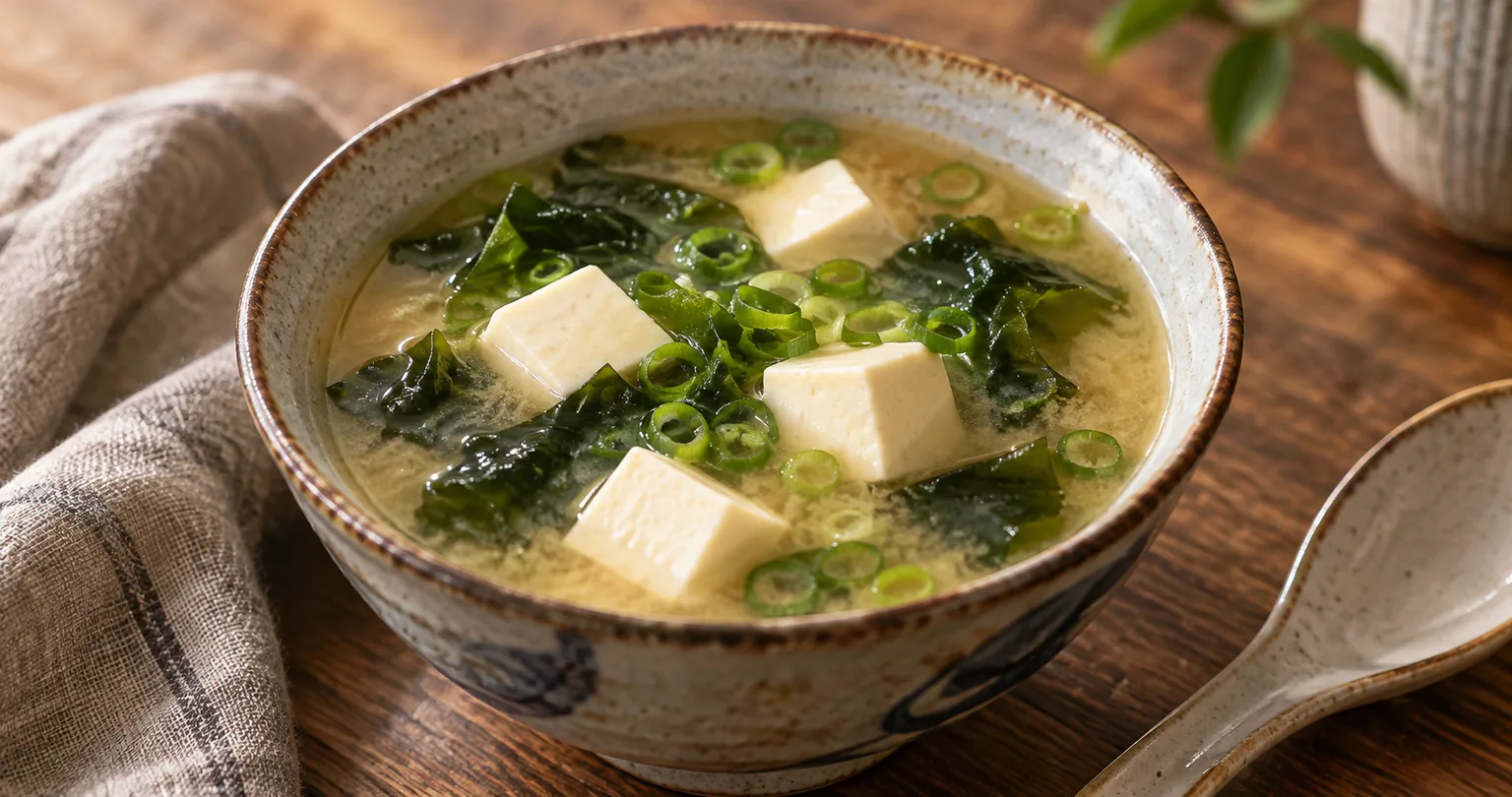
Miso soup
- Yield
- 4 servings
This small soup teaches two things you will use again and again: dashi, the quick broth of kelp and smoked bonito that sits under much of Japanese cooking, and the one rule of miso, which goes in last and never boils. Once you have both, it is an easy weeknight side for any rice meal.
IngredientsTips are one tap away.
Ingredients
Batches and reset
4 servings · US measures · 1 batch
Batching
Make one batch in each 3-quart saucepan; for a larger yield, use a second saucepan. Soaking, steeping and warming times and cues do not multiply with ingredient quantities.
Original recipe: 4 servings.
Extra miso and the optional extra hot water are to taste and excluded from the base nutrition scenario. White miso is the selected miso. Nutrition is incomplete because the flavor extracted from the removed kombu and strained bonito, the water left in the dashi and the dried wakame mass are not established.
Before you start
- Read through the recipe before heating the saucepan. Gather the saucepan, lined strainer and bowl, small bowl, whisk, ladle, slotted spoon, thermometer and the measured ingredients.
Directions
Read and gather
For the whole recipe
Read through the recipe and gather the equipment. Use the ingredient lines to prepare and measure everything. Wipe the kombu with a damp cloth but leave its white powder on, because that powder carries flavor. Everything is prepared and measured before the saucepan goes on the heat.
Soak the kombu
For each saucepan of soup
Soak 1 piece kombu (dried kelp) in about 4 1/2 cups cold water in a 3-quart saucepan until it softens and swells, about 30 minutes.
Heat the kombu slowly
For each saucepan of soup
Heat the saucepan over medium-low heat until tiny bubbles cling to the kombu and the sides of the pan and the water smells faintly of the sea, about 10 minutes. Lift out the kombu just before the water starts to simmer.
Steep the bonito flakes
For each saucepan of soup
Steep the bonito flakes in the hot water. Bring the water in the 3-quart saucepan to a simmer over medium heat, then turn off the heat. Add about 2 cups bonito flakes (katsuobushi) all at once and let them steep without stirring until they sink to the bottom, about 2 minutes.
Strain the dashi
For each saucepan of soup
Strain the dashi through the lined strainer into the bowl and let it drip without pressing the flakes. Rinse the saucepan and pour the dashi back in. The dashi is clear and pale gold.
Heat the dashi and warm the tofu and wakame
For each saucepan of soup
Heat the dashi over medium heat until it steams and trembles without bubbling. Add 1 tbsp dried cut wakame seaweed and the tofu, and warm them until the wakame unfurls and turns bright green, about 1 minute. Stir gently from here on so the tofu keeps its shape.
Turn off the heat and dissolve the miso
For each saucepan of soup
Turn off the heat. Whisk 3 tbsp white miso (shiro) with a ladleful of the hot dashi in the small bowl until smooth, then stir it back into the saucepan. If lumps remain, hold the strainer, without its liner, in the soup and push them through with the back of a spoon. The miso is fully dissolved, with no lumps.
Taste and adjust
For each saucepan of soup
Taste the soup. Aim for savory and gently salty, with a smoky, sea-air depth and a round, fermented sweetness. If it tastes thin or flat, whisk in white miso (shiro) to taste, a little at a time, the same way. If it tastes too salty, stir in extra hot water to taste. If the soup cools, rewarm it over low heat only until it steams; never let it boil once the miso is in. The soup tastes savory and gently salty.
Ladle and serve
For the whole recipe
Ladle the soup into bowls to make 4 servings, dividing the tofu and wakame evenly with the slotted spoon, and top each bowl with green onions. Serve right away. Refrigerate leftovers within two hours, and reheat them gently, without boiling, until an instant-read thermometer reads 165°F (74°C). The soup is portioned and topped.
About this recipe
Research preview: these details come from our sourced research and haven't been reviewed by our chef yet.
Why it works
Warming the kombu gently and lifting it out before the water simmers keeps the dashi clean, and a short steep of bonito flakes adds smoky depth without bitterness. The miso is whisked into a little hot dashi off the heat, so it dissolves smoothly and keeps its aroma.
Associated with
Japanese
Miso soup is the soup in the Japanese meal of one soup and side dishes (ichiju-sansai), and with white rice it is at the center of the traditional Japanese breakfast. Regional miso, such as Shinshu and Sendai, gives each area its own version.
Taste
- Sweet
- Sour
- Salty
- Bitter
- Savory
- Heat
Kombu and bonito dashi gives a smoky, sea-air depth., White miso adds gentle salt and a round, fermented sweetness. · light, clear broth with soft silken tofu cubes and slippery wakame · hot
Skill level
Easy
A short, forgiving process. The one rule is not to boil the soup once the miso is in.
Allergens
Contains: fish (skipjack tuna), soybeans.
Check the miso label for wheat. Plain bonito flakes are used here; instant dashi granules are a different product and can contain milk.
Diets
Vegetarian: Doesn't fit as written Pescatarian: Fits as listed Vegan: Doesn't fit as written Dairy: See the allergen lines Egg: See the allergen lines Gluten: See the allergen lines
Occasions
Everyday Japanese meals
Served with rice in a meal of one soup and side dishes (ichiju-sansai), including the traditional Japanese breakfast.
Serving and keeping
Best served: Right after the miso is dissolved In bowls with the tofu and wakame divided evenly, topped with green onions
Make ahead: Warm the dashi and whisk in the miso just before serving.
Storage: Refrigerate within 2 hours (1 hour above 90 °F / 32 °C). Plain dashi freezes for about 2 to 3 months for best quality; tofu changes texture when frozen, so freeze the dashi rather than the finished soup.
Leftovers: Best served right away; for later meals, keep the dashi and add the miso when serving.
Food safety
- Refrigerate leftovers within 2 hours (1 hour above 90 °F / 32 °C) and reheat to 165 °F (74 °C).
We make no statement about cross-contact in your kitchen or in packaged ingredients. Check the miso, tofu and seaweed labels.
Nutrition notes
Most of the sodium comes from the miso. Starting with less miso, and adjusting with dashi rather than more miso, keeps it lower.
Kombu is very high in iodine; frequent, large servings of kombu dashi can add a lot of iodine.
Swap notes
bonito flakes (katsuobushi) · vegetarian or vegan
Use: dried shiitake mushrooms, soaked with the kombu from the start
What changes: Soak them at least 30 minutes, then simmer the shiitake (not the kombu) about 10 minutes before straining.; The broth is earthier and less smoky.
Not a swap: Instant dashi granules; they are not the same as the flakes and can contain milk.
bonito flakes (katsuobushi) · orthodox.fast_strict
Use: dried shiitake mushrooms, soaked with the kombu from the start
What changes: The broth is earthier and less smoky.
Not a swap: Instant dashi granules; they are not the same as the flakes and can contain milk.
white miso (shiro) · halal.general
Use: miso without added alcohol
What changes: No change in taste.
Not a swap: A miso that lists alcohol as a preservative.
white miso (shiro)
Use: less miso to start, or a reduced-salt miso
What changes: Adjust with dashi rather than more miso.; The body is lighter.
Not a swap: Soy sauce in place of miso, which salts the broth but gives it no body.
white miso (shiro) · different miso on hand
Use: red (aka), mixed (awase) or barley (mugi) miso
What changes: Start low with red and barley miso, which are saltier.; Barley miso contains gluten; the allergen lines change.
Not a swap: Soy sauce in place of miso, which salts the broth but gives it no body.
green onions · buddhist.five_pungent
What changes: Leave out the green onions.
Not a swap: Chives or leek greens, which are also onion-family plants.
kombu (dried kelp) · no kombu on hand
Use: about half again as many bonito flakes, steeped the same way
What changes: The broth is smokier and thinner.
Not a swap: Sheets of nori, which break down into a murky green broth.
dried cut wakame seaweed · no wakame on hand
Use: a handful of baby spinach, or thinly sliced napa cabbage
What changes: Spinach goes in with the tofu and wilts in seconds; napa needs about 2 minutes of simmering before the miso goes in.
Not a swap: Dried hijiki, which needs a long soak and tastes of iron.
silken tofu · passover.ashkenazi
Not a swap: Miso and tofu are the soup, and both are kitniyot or chametz; no tested stand-in is recorded.
These notes don't change the amounts, allergens or nutrition shown for this recipe.
For your food tracker
Fields for MyFitnessPal and other trackers
- Recipe url
- https://isthebestrecipe.com/soups/miso-soup
- Name
- Miso soup
- Servings
- 4
- Recipe yield
- 4 servings
- Recipe ingredient
- 1 piece kombu (dried kelp) about 4 by 6 inches (10 g), wiped with a damp cloth, white powder left on, about 4 1/2 cups cold water, about 2 cups bonito flakes (katsuobushi) loosely packed, 1 tbsp dried cut wakame seaweed, about 7 oz silken tofu cut into 1/2-inch cubes, 3 tbsp white miso (shiro), 2 whole green onions thinly sliced
- Copy action wording
- Copy recipe and estimated nutrition
Sources
- Miso soup (Wikipedia, 2026-10-07)
- 味噌汁 (ウィキペディア (Japanese Wikipedia), 2026-10-06)
- Dashi (Wikipedia, 2026-08-05)
- Katsuobushi (Wikipedia, 2025-12-20)
- Food Allergen Labeling and Consumer Protection Act of 2004 (FALCPA) (U.S. Food and Drug Administration, 2022-11-29)
- FASTER Act: Sesame Is the Ninth Major Food Allergen (U.S. Food and Drug Administration, 2024-04-12)
- Guidance for Industry: Questions and Answers Regarding Food Allergen Labeling (Edition 5) (U.S. Food and Drug Administration, 2025-01-06)
- Regulation (EU) No 1169/2011, Annex II: Substances or products causing allergies or intolerances (The National Archives (legislation.gov.uk), reproducing the EU Official Journal text, 2014-02-19)
- Cold Food Storage Chart (FoodSafety.gov (U.S. HHS/USDA/FDA))
- Leftovers and Food Safety (USDA Food Safety and Inspection Service)
- Danger Zone 40°F - 140°F (USDA Food Safety and Inspection Service)
- Safe Minimum Internal Temperature Chart (FoodSafety.gov (U.S. HHS/USDA/FDA), 2024-11-21)
- アレルギー表示について (Allergen labelling: specified raw materials, as of April 2026) (消費者庁 Consumer Affairs Agency, Japan, 2026-04-01)
- FoodData Central branded label: BONITO SOUP STOCK (FDC 2590997) (USDA Agricultural Research Service / brand owner (not supplied), 2023-06-29)
- Sodium in Your Diet (U.S. Food and Drug Administration, 2025-02-27)
- Daily Value on the Nutrition and Supplement Facts Labels (U.S. Food and Drug Administration, 2024-09-09)
- FoodData Central: Miso (FDC 172442) (USDA Agricultural Research Service, 2019-04-01)
- FoodData Central branded label: BONITO FLAKES (FDC 2025412) (USDA Agricultural Research Service / brand owner Eden Foods, Inc., 2021-10-28)
- FoodData Central: MORI-NU, Tofu, silken, soft (FDC 174292) (USDA Agricultural Research Service, 2019-04-01)
- Kombu (Wikipedia, 2026-04-03)
Make it the best
Copy this recipe and make it your own. Change amounts, swap ingredients, rewrite steps. The original stays as it is.
Nutrition Values
Nutrition estimates aren’t available for this recipe yet.
Your notes
Kept on this device.Return: https://isthebestrecipe.com/soups/miso-soup