
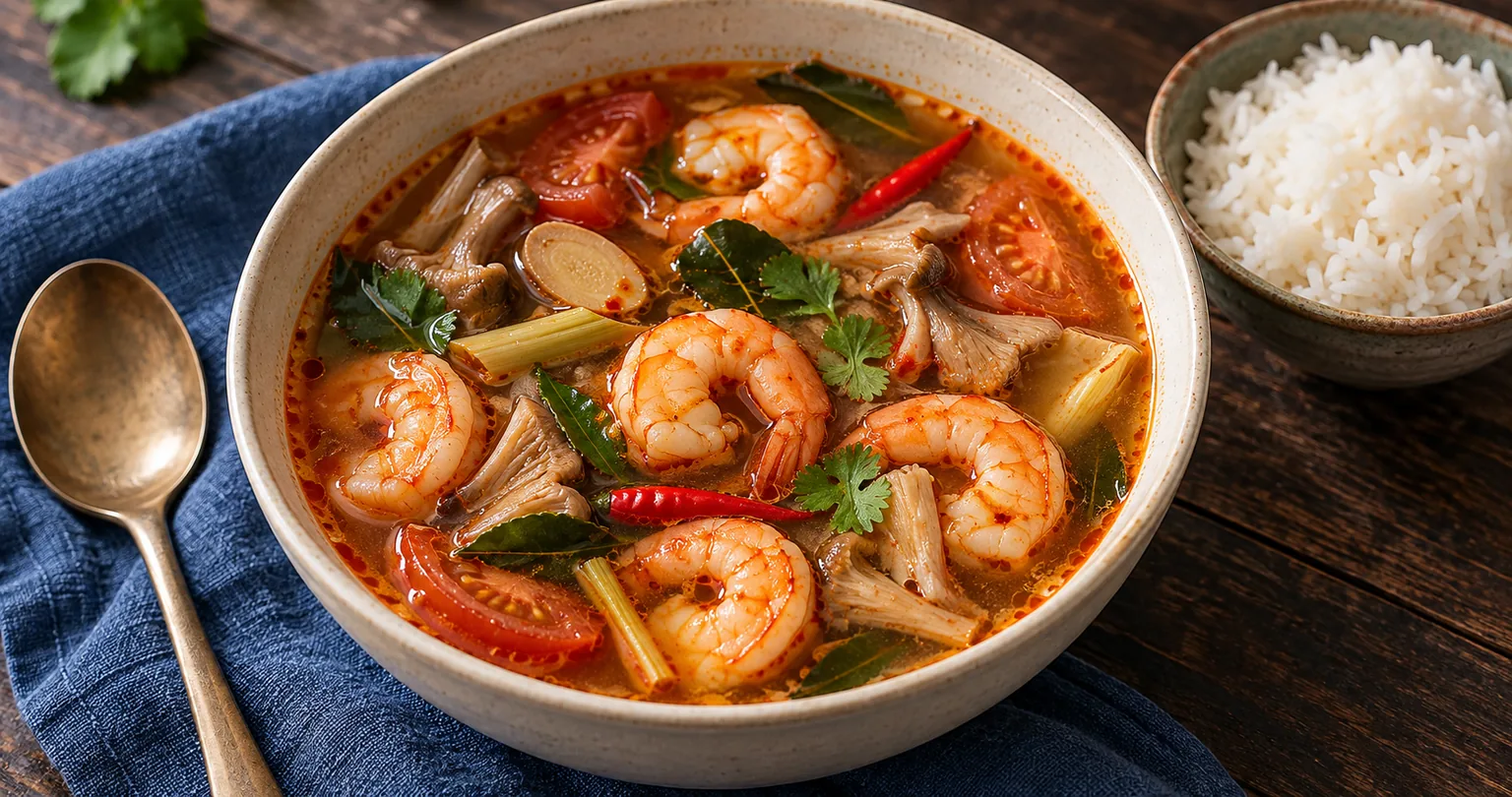
Tom yum soup
- Yield
- 4 servings
Tom yum shows how a handful of hard, fragrant aromatics becomes a whole broth in minutes, and how Thai cooks balance sour, salty, hot and sweet at the very end. The shrimp shells you peel off become a quick broth, so nothing goes to waste.
IngredientsTips are one tap away.
Ingredients
Batches and reset
4 servings · US measures · 1 batch
Batching
Cook one batch in each 4-quart saucepan; for a larger yield, use a second saucepan. Simmering, infusing and poaching times and cues do not multiply with ingredient quantities.
Original recipe: 4 servings.
The optional jasmine rice and any extra chili paste, fish sauce, sugar or lime juice are excluded from the base nutrition scenario. Water is the selected broth base, so the soup is pescatarian (shrimp and fish sauce). Nutrition is incomplete because the edible shrimp mass after peeling, the aromatics that are not eaten, the chilies, the chili paste and the water left after simmering are not established.
Before you start
- Read through the recipe before heating the saucepan. Gather the saucepan, strainer and heatproof bowl, knife or pestle, juicer, ladle, thermometer and the measured ingredients.
Directions
Read and gather
For the whole recipe
Read through the recipe and gather the equipment. Use the ingredient lines to prepare and measure everything, and start the jasmine rice now if you are serving it. Put the shrimp shells in the saucepan and keep the peeled shrimp in the refrigerator until they go into the pot. Everything is prepared and measured before the saucepan goes on the heat.
Simmer the shells into a quick broth
For each saucepan of soup
Simmer the shells from the about 1 lb large shrimp with about 5 cups water in a 4-quart saucepan over medium-high heat. Once it bubbles, lower to medium-low heat so only small, lazy bubbles rise, and simmer until the broth smells sweet and briny and turns faintly pink-orange, about 10 minutes. Strain it into the heatproof bowl, pressing the shells only lightly, then discard the shells and pour the broth back into the saucepan.
Add the aromatics and infuse
For each saucepan of soup
Add 3 stalks lemongrass, 1 piece fresh galangal, 6 whole makrut lime leaves and 3–6 whole Thai bird chilies. Keep the broth at a gentle simmer over medium-low heat until the kitchen smells strongly of lemongrass and lime leaf, about 5 minutes.
Stir in the mushrooms, tomato and seasonings
For each saucepan of soup
Stir in about 8 oz oyster mushrooms, the tomato wedges, 1 tbsp Thai roasted chili paste (nam prik pao), 3 tbsp fish sauce and 1 tsp sugar. Simmer over medium-low heat until the mushrooms soften and the tomato edges start to slump, about 2 minutes.
Add the shrimp and poach
For each saucepan of soup
Add the peeled shrimp and poach them in barely bubbling broth over medium-low heat until they curl into a loose C and the flesh is pearly and opaque all the way through, about 2 minutes. Cut the thickest shrimp open to check: shrimp are safely cooked when the flesh is pearly and opaque, with no glassy center (FoodSafety.gov). Take the saucepan off the heat as soon as the centers turn opaque; a tight O curl means they have gone too far.
Turn off the heat and add the lime juice
For each saucepan of soup
Turn off the heat and stir in about 1/4 cup fresh lime juice. The broth smells bright and limey.
Taste and adjust
For each saucepan of soup
Taste the broth. Aim for sour first, then salty, then hot, with a little sweetness and a strong smell of lemongrass and lime leaf. If it tastes flat or thin, add fish sauce to taste, a little at a time. If it is not sour enough, add fresh lime juice to taste. If it tastes sour but harsh, add sugar to taste. If it is not hot enough, stir in Thai roasted chili paste (nam prik pao) to taste. The broth tastes sour, salty, hot and a little sweet.
Ladle and serve
For the whole recipe
Ladle the soup into bowls to make 4 servings, dividing the shrimp, mushrooms and tomato evenly, and sprinkle about 1/4 cup cilantro leaves over the top. Serve with steamed jasmine rice, if using. Tell everyone the lemongrass, galangal and lime leaves are there for aroma, not for eating. Refrigerate leftovers within two hours and reheat them to 165°F (74°C), adding fresh lime only after reheating. The soup is portioned and garnished.
About this recipe
Research preview: these details come from our sourced research and haven't been reviewed by our chef yet.
Why it works
Simmering the shrimp shells makes a sweet seafood stock in minutes. Bruised lemongrass and chilies release their oils fast, the shrimp poach only until opaque so they stay tender, and the lime goes in off the heat, because boiled lime juice tastes cooked and flat.
Associated with
Thai
Tom yum kung is a central Thai soup eaten across Thailand. Before mass tourism the fish version, tom yam pla, was the most widespread; the creamy style dates from the 1980s. In 2024 UNESCO added tom yum kung to its list of intangible cultural heritage.
Taste
- Sweet
- Sour
- Salty
- Bitter
- Savory
- Heat
Sour lime and salty fish sauce lead, then chili heat and a little sweetness., Lemongrass, galangal and makrut lime leaves perfume the broth. · clear, aromatic broth with snappy shrimp and tender mushrooms · hot
Skill level
Easy
Short cooking with a final balancing step. The shrimp need watching so they stay tender.
Allergens
Contains: shrimp, fish.
Check the fish sauce and roasted chili paste labels: some fish sauces add hydrolyzed vegetable protein (often soy or wheat), and chili pastes vary.
Diets
Vegetarian: Doesn't fit as written Pescatarian: Fits as listed Vegan: Doesn't fit as written Dairy: See the allergen lines Egg: See the allergen lines Gluten: See the allergen lines
Occasions
Lenten abstinence days (Ash Wednesday and the Fridays of Lent)
Shrimp and fish sauce are seafood, which the abstinence rule allows, and this edition uses water rather than chicken broth.
Everyday Thai meals
An everyday dish eaten with rice; we found no festival tied to it, and its UNESCO listing is a heritage recognition, not an occasion.
Serving and keeping
Best served: Right after the lime goes in and the final taste In bowls with the shrimp, mushrooms and tomato divided evenly and cilantro on top, with jasmine rice on the side
Make ahead: Poach the shrimp and add the lime when serving.
Storage: Refrigerate within 2 hours (1 hour above 90 °F / 32 °C), in shallow containers. The broth freezes for about 2 to 3 months for best quality; shrimp toughen when reheated, so freeze the broth without them.
Leftovers: Shrimp toughen when reheated. The lemongrass, galangal and lime leaves are for aroma, not for eating.
Food safety
- Keep the peeled shrimp in the refrigerator until they go into the pot.
- Cook shrimp until the flesh is pearly and opaque all the way through; cut the thickest one open to check.
- Lemongrass, galangal and lime leaves are for aroma; tell everyone not to eat them.
- Refrigerate leftovers within 2 hours (1 hour above 90 °F / 32 °C) and reheat to 165 °F (74 °C).
- Cooked rice left at room temperature for more than 2 hours should be thrown away.
We make no statement about cross-contact in your kitchen or in packaged ingredients. Check the fish sauce and chili paste labels.
Nutrition notes
Most of the sodium comes from the fish sauce. Using less, and balancing with lime and sugar before adding more, keeps it lower.
Some raw shrimp is sold with moisture-retaining additives that add sodium; the label lists them.
Swap notes
large shrimp · vegetarian
Use: extra-firm tofu and more mushrooms, same weight
What changes: Skip the shell stock and simmer the aromatics in vegetable broth.; Use a vegetarian chili paste, and light soy sauce in place of the fish sauce, about two-thirds as much.; No seafood sweetness; still sour and hot.
Not a swap: A standard roasted chili paste, which usually contains dried shrimp and fish.
large shrimp · sda.clean_meats
Use: firm white fish in large chunks (tom yam pla, a traditional version)
What changes: Skip the shell stock and use water.; Use a chili paste made without shrimp.; Simmer the fish gently until it is opaque and flakes easily with a fork, or reaches 145 °F (63 °C).
Not a swap: A standard roasted chili paste, which usually contains dried shrimp.
large shrimp · kosher.mainstream
Use: a kosher white fish in large chunks (tom yam pla, a traditional version)
What changes: Skip the shell stock and use water.; Use certified fish sauce and a certified chili paste made without shrimp.; Simmer the fish gently until it is opaque and flakes easily with a fork, or reaches 145 °F (63 °C).
Not a swap: Chicken broth with the fish; kosher practice does not cook fish with meat.
large shrimp · passover.ashkenazi
Not a swap: Shrimp is never kosher; a Passover version would need a kosher fish and certified pantry items, which is not tested here.
fish sauce · orthodox.fast_strict
Use: light soy sauce with a pinch of salt, about two-thirds as much
What changes: Also use a chili paste made without fish.; Less savory depth and a darker broth.
Not a swap: A chili paste that lists fish sauce or dried fish.
fish sauce
Use: about half the fish sauce, plus a little extra lime
What changes: Balance with lime and sugar before adding more fish sauce.; Brighter and less savory.
Not a swap: Salt added to make up for less fish sauce, which puts the sodium back.
Thai roasted chili paste (nam prik pao) · buddhist.five_pungent
Use: a chili paste made without garlic or shallot, or leave it out
What changes: Without paste the soup is clear and lighter; add a little more sugar and a few more chilies.
Not a swap: An ordinary roasted chili paste, which contains garlic and shallot.
fresh galangal · no galangal on hand
Use: fresh ginger, a little less
What changes: Sharper and hotter, less piney.
Not a swap: Fresh turmeric root, which looks similar in the store and tastes nothing alike.
lemongrass · no lemongrass on hand
Use: wide strips of lemon zest plus a few more lime leaves
What changes: Less rounded; lift the zest out before serving.
Not a swap: The dry green tops alone, which carry little flavor.
makrut lime leaves · no makrut lime leaves on hand
Use: wide strips of lime zest
What changes: Less perfumed; lift the zest out before serving.
Not a swap: Bay leaves, which bring a different flavor entirely.
oyster mushrooms · no oyster mushrooms on hand
Use: drained, halved straw mushrooms; quartered cremini; or enoki
What changes: Cremini need about 1 more minute; enoki go in with the shrimp.
Not a swap: Dried shiitake, whose woodsy flavor takes over the broth.
These notes don't change the amounts, allergens or nutrition shown for this recipe.
For your food tracker
Fields for MyFitnessPal and other trackers
- Recipe url
- https://isthebestrecipe.com/soups/tom-yum-soup
- Name
- Tom yum soup
- Servings
- 4
- Recipe yield
- 4 servings
- Recipe ingredient
- about 1 lb large shrimp shell-on, 21 to 25 per pound, peeled and deveined, shells saved for the broth, about 5 cups water, 3 stalks lemongrass trimmed to the pale lower part, cut into 2-inch lengths and bruised with the flat of a knife, 1 piece fresh galangal about 2 inches long, cut into thin coins, 6 whole makrut lime leaves center ribs torn out, 3–6 whole Thai bird chilies stems removed, lightly smashed, about 8 oz oyster mushrooms torn into bite-size pieces, 1 whole medium tomato cut into 8 wedges, 1 tbsp Thai roasted chili paste (nam prik pao), 3 tbsp fish sauce, 1 tsp sugar, about 1/4 cup fresh lime juice from 2 to 3 limes, about 1/4 cup cilantro leaves loosely packed
- Copy action wording
- Copy recipe and estimated nutrition
Sources
- Tom yum (Wikipedia, 2026-09-20)
- ต้มยำกุ้ง (วิกิพีเดีย (Thai Wikipedia), 2026-02-16)
- Food Allergen Labeling and Consumer Protection Act of 2004 (FALCPA) (U.S. Food and Drug Administration, 2022-11-29)
- FASTER Act: Sesame Is the Ninth Major Food Allergen (U.S. Food and Drug Administration, 2024-04-12)
- Guidance for Industry: Questions and Answers Regarding Food Allergen Labeling (Edition 5) (U.S. Food and Drug Administration, 2025-01-06)
- Regulation (EU) No 1169/2011, Annex II: Substances or products causing allergies or intolerances (The National Archives (legislation.gov.uk), reproducing the EU Official Journal text, 2014-02-19)
- Cold Food Storage Chart (FoodSafety.gov (U.S. HHS/USDA/FDA))
- Leftovers and Food Safety (USDA Food Safety and Inspection Service)
- Safe Minimum Internal Temperature Chart (FoodSafety.gov (U.S. HHS/USDA/FDA), 2024-11-21)
- Nam phrik phao (Wikipedia, 2026-06-07)
- Sodium in Your Diet (U.S. Food and Drug Administration, 2025-02-27)
- Daily Value on the Nutrition and Supplement Facts Labels (U.S. Food and Drug Administration, 2024-09-09)
- FoodData Central: Sauce, fish, ready-to-serve (FDC 174531) (USDA Agricultural Research Service, 2019-04-01)
- FoodData Central: Crustaceans, shrimp, raw (FDC 175179) (USDA Agricultural Research Service, 2019-04-01)
- FoodData Central: Soup, chicken broth, low sodium, canned (FDC 171609) (USDA Agricultural Research Service, 2019-04-01)
Make it the best
Copy this recipe and make it your own. Change amounts, swap ingredients, rewrite steps. The original stays as it is.
Nutrition Values
Nutrition estimates aren’t available for this recipe yet.
Your notes
Kept on this device.Return: https://isthebestrecipe.com/soups/tom-yum-soup